Two businesses ask the same question in the same week. A shop selling candles wants to know why anyone would take a bank transfer. A joinery workshop taking 3,000 commissions wants to know why anyone would pay 1.5% to a card processor for the privilege.
Both are right, and they are right about different businesses. The payment method is not a technical setting, it is a decision about who is carrying the risk and who is waiting.
The four methods, and what each one really costs
- Card. The customer pays now, the money is captured before you do any work, and the fee is a percentage. This is the default for anything low-value and high-volume, because the alternative is chasing people for amounts smaller than the time it takes to chase them.
- Bank transfer. No processing fee, but the money arrives when it arrives and somebody has to check. Suited to larger, less frequent invoices where a percentage fee is real money and the customer is a business used to paying this way.
- Cash on delivery or on collection. The customer pays when they receive the goods. It removes the payment barrier entirely, which is why it converts so well, and it moves all the risk onto you: an unpaid delivery is a delivery you funded.
- Cheque. Rare, slow, and still the way some organisations and older customers prefer to pay. Costs nothing to offer and occasionally wins an order you would otherwise lose.
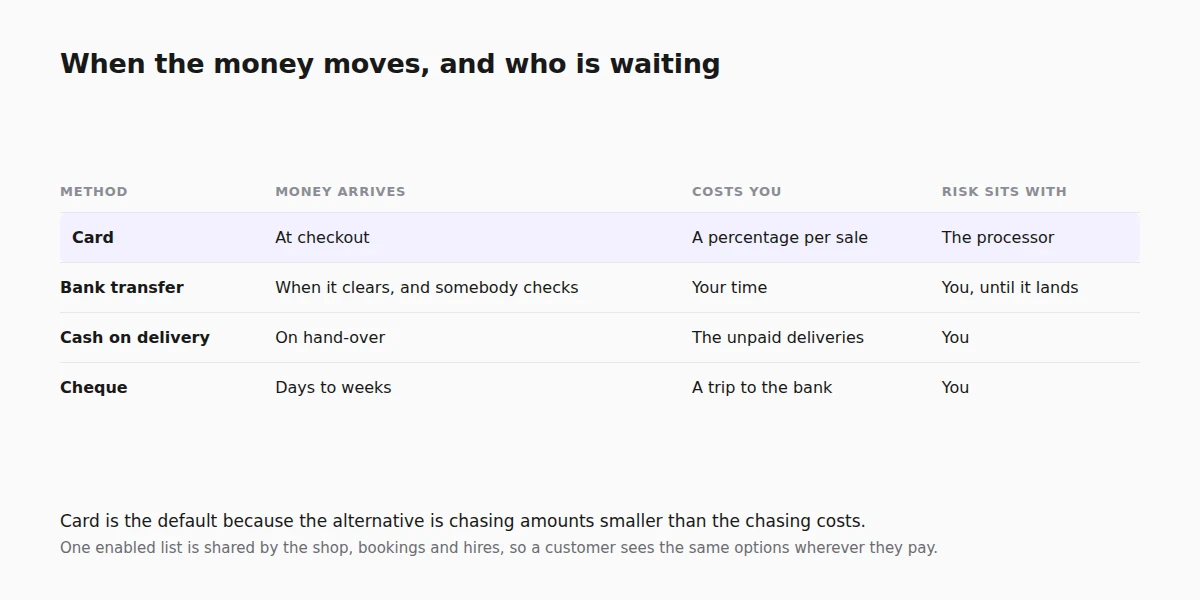
The right answer for most small businesses is card plus exactly one alternative, chosen because your customers actually asked for it. Offering all four to everyone is not generosity, it is a longer checkout.
One list, three places it is used
Worth knowing before you go looking for three separate settings screens: the enabled payment methods are a single project-wide list. Whatever you switch on is what a shop checkout offers, what a booking asks for, and what a hire reservation takes.
That is deliberate. A business has one way of getting paid, not three, and the older design where each module kept its own subset produced exactly the confusion you would expect: a customer paying by card for a product and being asked for a bank transfer for an appointment.
Card is the one method that cannot simply be ticked. It only appears once the connection to the payment processor is live and able to accept charges, which is a short setup and is covered in accepting payments with Stripe. Until that is done, the option is not offered rather than being offered and failing.
Bank transfer only works with the details attached
If you enable bank transfer, the account details have to travel with the order confirmation. The failure mode is a customer who chose "bank transfer", received a thank-you page, and then had to email asking where to send the money. Half of them do not email.
Put the details on the confirmation and in the confirmation email, along with a reference the customer can quote, which is usually the order number. Then decide who checks the account and how often, because bank transfer is the one method that needs a human in the loop. That is the real cost of the zero fee.
Deposits, for work you have to schedule
There is a fifth option that is not a payment method at all: taking part of the money up front.
For an appointment, a hire or anything else that reserves your time, a deposit does a different job to a payment. It is not there to collect revenue early, it is there to make the customer's commitment real. A booking with 20 attached behaves completely differently to a free one, which is the entire argument in cutting no-shows with booking deposits.
One mechanical detail worth knowing if you take deposits by card: an unpaid card booking does not hold its slot indefinitely. If the customer starts a card payment and never finishes it, the slot is released after a short hold and offered to somebody else, so an abandoned checkout does not quietly block your diary for a week.
Gift cards are money in advance
A gift card inverts the whole model: the money arrives before anything is chosen, and the redemption happens later, sometimes never. For a shop with any kind of seasonal peak this is the single most underused instrument on the list, and it is a better response to "how do I get more revenue this month" than a discount code is, because a discount takes money out and a gift card puts it in.
The practical details, including balances and part-redemption, are in gift cards, and the business case is in gift cards for a small business.
Say which methods you take, before checkout
Whatever you choose, put it somewhere a customer can see before they have filled in an address. The payment step is the worst possible place to discover that a shop does not take the only method you have.
A single line in the footer and on the delivery information page is enough: "We accept card and bank transfer. Collection orders can be paid on collection." That sentence prevents a category of abandonment that no amount of checkout optimisation will, and it costs nothing to write. What a checkout here includes is summarised on the online store builder page.
FAQ
Do I need a merchant account to take cards?
No. Card payments run through a payment processor that handles the merchant side; you connect an account and the payouts arrive in your bank. The connection has to be complete and able to accept charges before the card option appears at checkout.
Is cash on delivery worth offering?
It converts extremely well and it carries real risk: refused deliveries, unpaid parcels and the cost of the return. It suits local delivery and collection, where the goods have not travelled far and the customer is nearby. It suits sending a parcel across a continent much less.
Can I take a deposit rather than the full amount?
For bookings and hires, yes, and it is usually the better default for anything that reserves time. The deposit is set as a fixed sum or a share of the total, and the balance is taken later.
Do the payment methods differ between my shop and my booking form?
No. The enabled list is project-wide and shared by the shop, bookings and rentals, so a customer sees the same options wherever they pay you.
What about invoicing a business customer?
Bank transfer with the details and a reference on the confirmation is the closest thing to an invoice flow, and it is what most small businesses use for larger one-off jobs where a card fee would be a noticeable amount of money.
Read next
- How online payments increase car rental bookings - the same argument, measured on hire bookings.