
Ask a small business owner what they could change this month to get more customers and reviews rarely come up. Ask what makes them pick one unfamiliar company over another and it is the first answer.
Reviews are unusual among ranking factors: they are visible to customers, they are influenced by ordinary work rather than technical skill, and a business with fifteen recent ones beats a business with four from 2023.
Ask in person, at the moment it went well
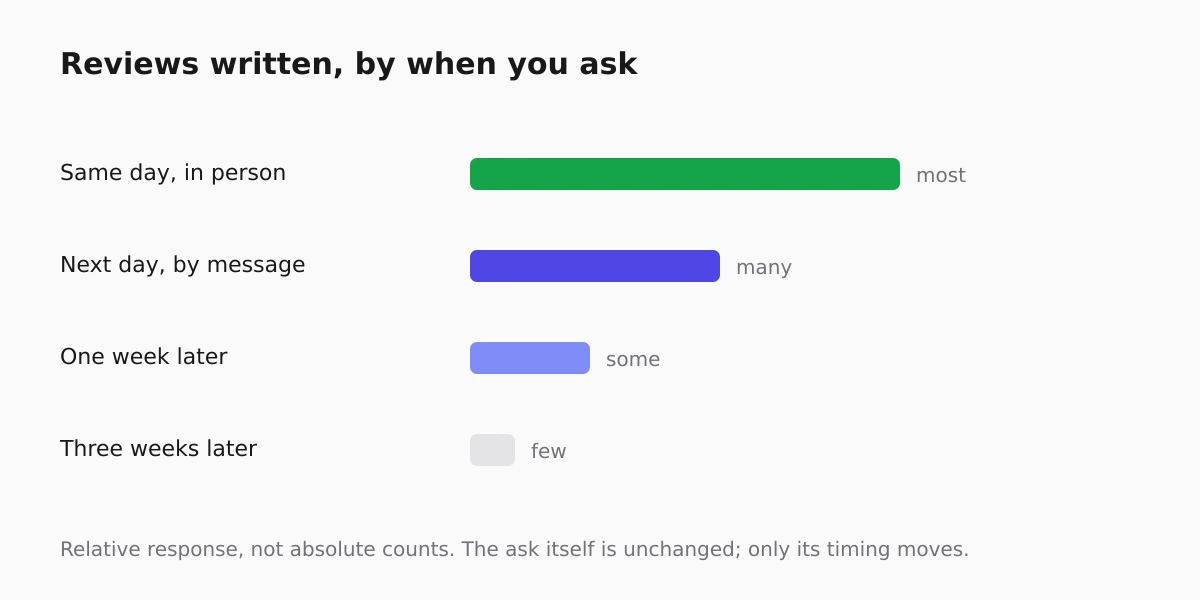
The single biggest determinant of whether a review gets written is when you ask. At the end of a job that went well, face to face, with the customer still holding the result, works. An email three weeks later does not.
The second determinant is how easy you make it. A short link or a QR code on the receipt removes the search step, and that step is where most intentions die.
Make it a routine, not a campaign
Businesses that get reviews steadily have made asking part of a process: the last line of a job sheet, a step in the handover, a sentence in the closing message. Businesses that run a review push get a spike, then nothing.
Steady beats spiky for another reason: recency is weighted. A regular trickle keeps the profile looking alive.
Never incentivise, never write them
Offering a discount for a review violates the terms of every major platform and, when it is discovered, costs the reviews and sometimes the profile. Writing them yourself is worse.
The upside is smaller than it looks anyway. Fake reviews read as fake to customers, who are far better at spotting them than businesses assume.
Reply to everything, briefly
A short, specific reply to a positive review is read by the next customer, not by the reviewer. Two sentences is plenty.
Negative reviews deserve the same brevity and no defensiveness. Acknowledge, state what you have done, offer to continue offline. Never argue the facts in public and never discuss anything confidential, which matters especially for health and personal services.
Put them where the decision happens
A review page nobody visits does less than three reviews beside the booking button, which is where the booking website builder puts them. Quote them next to the point where somebody is deciding, with a name and a date attached.
For a practice, a salon or a clinic, that is often the strongest trust element on the page: see what patients look for on a clinic website for the full ordering.
Then let them do SEO work
Reviews feed the local results that a small business can realistically compete in. The rest of that picture, from profile accuracy to location pages, is in SEO basics for beginners, and the templates most affected by it are the local ones in the health and medical and service categories.
FAQ
How many reviews do I need?
Enough to look current rather than to hit a number. A handful from the last few months does more than fifty that stop two years ago.
What is the best time to ask?
Immediately after the work is done and the customer is happy, in person if possible. Every day of delay reduces the response rate.
Should I reply to positive reviews?
Yes, briefly. The audience is the next customer reading the profile, not the person who wrote it.
How should I handle an unfair review?
Reply once, calmly, with the facts you can share publicly, and offer to take it offline. A measured reply under an unfair review persuades readers more than the review does.
Can I ask customers to remove a review?
You can ask, once, and only after resolving the problem. Pressuring somebody is how a bad review becomes a bad review plus a story about being pressured.