
Most small business analytics setups answer one question: how many people came. That number moves for reasons nobody controls, cannot be acted on, and makes a quiet week feel like a failure.
The useful questions are narrower. Did anybody try to become a customer, where did they come from, and where did the ones who tried give up.
The four numbers worth watching
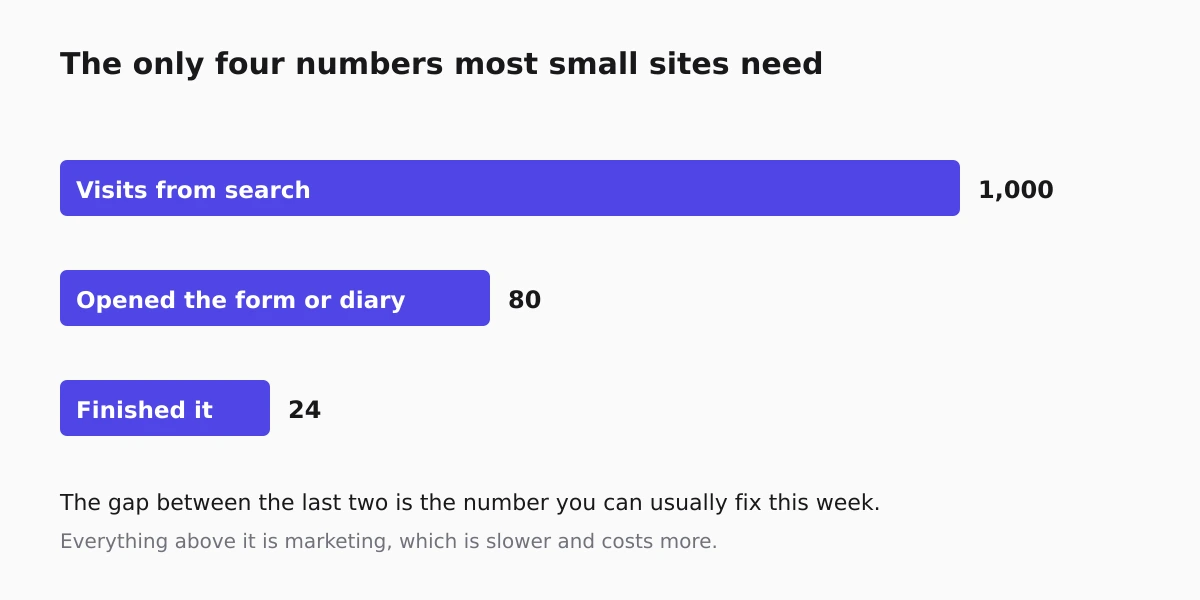
- Visits from search, separated from everything else, because that is the audience you are building.
- Enquiry or booking starts, meaning somebody opened the form or the diary.
- Completions, meaning they finished.
- The gap between the last two, which is the only number on this list you can usually fix this week.
Everything else is context. Time on page, bounce rate and page views tell you almost nothing at small volumes, where a single unusual visitor moves the average.
Measure the step, not the page
A page view tells you somebody arrived. A step tells you somebody tried. The difference matters because the fix for "few visitors" is marketing, which is slow and expensive, while the fix for "visitors who start and do not finish" is usually a form field or a missing price, which is an afternoon.
Setting that up is what conversion funnels is for, and the numbers it produces are the ones worth putting in front of yourself weekly.
Give it enough time to mean something
At a few hundred visits a month, a week is noise. Compare month against month, or the same month last year, and resist reading a two-day dip as a trend.
This is the most common analytics mistake in a small business: acting on a number that had no chance of being stable.
Watch the pages that already work
Your best page is usually not your homepage. Find the two or three pages that bring search visitors, and improve those before writing anything new, because they already have the audience new pages have to earn.
The same logic drives website traffic but no bookings: traffic and conversion fail for unrelated reasons, and fixing the wrong one wastes the work.
Know when you have enough measurement
A small business needs to know where customers come from and where they give up. It does not need heat maps, session recordings or a dashboard nobody opens.
If a number would not change what you do next week, stop collecting it. That single test removes most of what a default analytics setup shows you. The analytics dashboard covers what is available without adding anything else.
FAQ
How much traffic do I need before analytics is useful?
Enough that a month has a few hundred visits. Below that, look at enquiries and bookings directly rather than at rates, because percentages built on tiny numbers mislead.
Is bounce rate worth watching?
Rarely, on a small site. A visitor who found your phone number and left has bounced, and that was a success.
Should I track every button?
No. Track the steps that lead to money: the form opening, the booking starting, the checkout beginning, and each of those completing.
What is a good conversion rate?
Yours, last month. External benchmarks mix industries and traffic sources that have nothing to do with your business.
Do I still need this if I get customers by word of mouth?
Then measure less, but keep the enquiry path instrumented. Word-of-mouth customers still check the site before calling, and that check is where you lose some of them.