
A three-bedroom semi sits on your site for eleven days. The stats say ninety-four people opened it. Nobody asked for a viewing.
The property is not the problem and the price is usually not the problem either. What went wrong is that the listing answered the questions nobody asks and left the ones everybody asks to an email.
The twenty seconds before anyone reads a word
A buyer scrolling a results page is not reading. They are eliminating. In the first few seconds they check the price, the number of bedrooms, the area and the first photograph, and they either open the listing or they never think about it again.
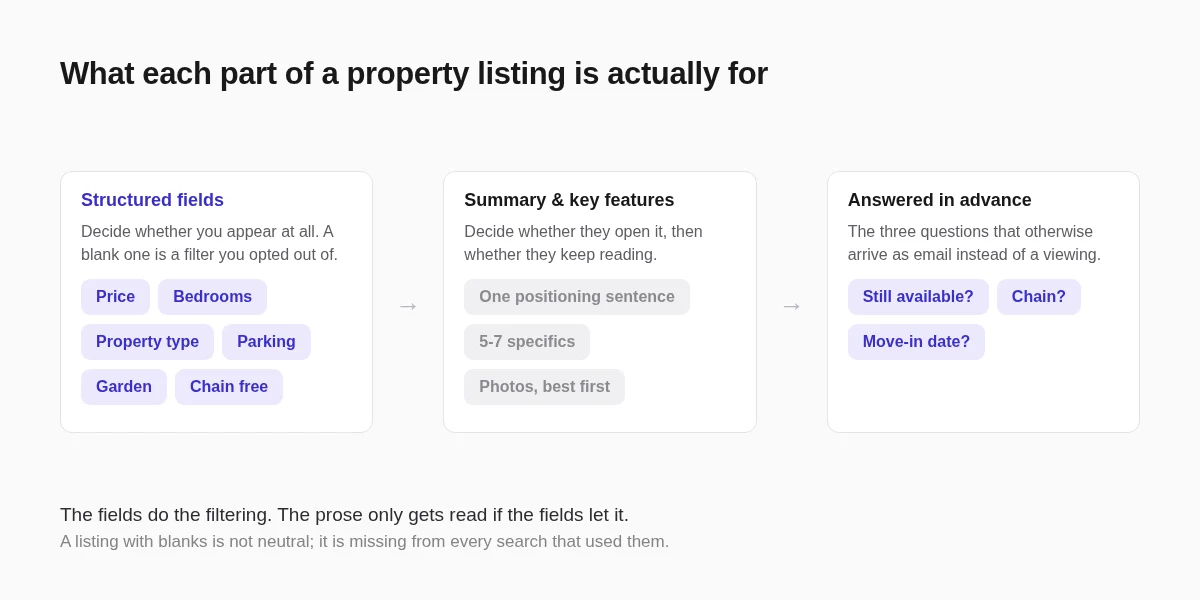
That means the four things doing the most work are the four that are hardest to write badly, because they are structured fields rather than prose. Get them exactly right and the prose gets a chance.
The summary is not the description
Two separate things, and putting the same text in both is the most common mistake.
The summary is one or two sentences that appear on the results card and at the top of the listing. It should say what this property is and who it suits: "A double-fronted Victorian terrace on a quiet cul-de-sac, five minutes from the station, with a south-facing garden and no onward chain."
The description is where the rooms live. Buyers read it after they have decided they are interested, so it is allowed to be long, and it should be specific: dimensions, which way rooms face, what was replaced and when.
Key features: five to seven, all specific
The bulleted feature list is the most-read part of a listing after the photos, and it is usually wasted on adjectives. "Spacious lounge" tells a buyer nothing. "22ft south-facing lounge with a working fireplace" tells them whether their sofa fits and whether the room gets afternoon light.
Write the five to seven things that would make somebody choose this property over the identical one two streets away, and cut anything true of every house on the road.
The fields buyers filter on
Some of what you enter is read. Some of it is searched. The searched ones matter more, because a missing value does not make a listing look thin, it makes the listing invisible to anyone who used that filter.
On a site built here, the fields a buyer can narrow by are the property type, whether there is parking, whether there is a garden, and on a sale whether it is chain free. On a letting they are the furnishing, and whether pets are allowed. Leave any of those empty and you have opted out of a filter rather than answered it neutrally.
The rest are read rather than filtered, and they still close the gap between a click and an email: EPC rating, council tax band, tenure, heating, year built, receptions, service charge and ground rent on a leasehold. A UK listing has to advertise an EPC rating in any case, so there is no version of this where leaving it out saves work.
The three facts people email to ask
Watch the enquiries on any agency site and the same three questions arrive over and over: is it still available, is there a chain, and when can I move in.
All three are fields. Availability is the listing status, the chain answer is a checkbox on a sale, and the move-in date is the available-from date. A listing that fills them in does not receive those emails, which sounds like a loss until you notice that the enquiries you do receive are all from people ready to book a viewing.
Photographs, in order
Photo order is the one place where the obvious answer is right: lead with the best exterior shot, then the main living space, then the kitchen, then bedrooms, then the garden, then the floorplan.
Two rules earn their place. Never lead with a bathroom. And upload the largest version you have rather than a phone screenshot of it, because the listing renders its own smaller sizes and cannot invent detail that was thrown away before it arrived. The same logic as image optimisation on any small site.
A floorplan is worth more than three extra photos. So is a video tour link, if one exists, because it removes the second viewing rather than the first.
What to leave out
- The agency's own history. Nobody chose a house because the agent has been trading since 1998.
- Capitalised shouting. STUNNING reads as a listing that needs help.
- Measurements you have not checked. They end up in a complaint.
- Anything you would have to withdraw. A "quiet road" beside a school at 3pm is a wasted viewing and a bad review.
FAQ
How long should a property description be?
Long enough to cover every room and the things a buyer cannot see in a photo, which is usually 250 to 500 words. Length is not the risk. Vagueness is: a 600-word description with no dimensions in it is worse than a 200-word one with them.
Should I put the price on a listing or use "price on application"?
Put the price on. Price on application exists for genuinely exceptional properties and for sellers who insist, and every time it is used on an ordinary house it removes that listing from the price filter, which is the first filter almost every buyer sets.
Do I need an EPC rating before I can advertise?
In the UK you need to have commissioned one before marketing starts, and the rating has to be advertised. Entering it as a field rather than burying it in the description also means it shows on the listing where a buyer expects to find it.
What is the difference between the summary and the key features?
The summary is a sentence that positions the property for someone still deciding whether to open it. The key features are the five to seven specifics that make it different from its neighbours. The summary sells the click, the features sell the viewing.
Where this goes next
Listings and their fields are set up in property listings and settings, and the whole module, including the enquiry side, is described on the estate agent website builder page.
Once the listings are right, the next thing that leaks viewings is what happens after somebody clicks "enquire", which is handled here.
Compare your options
- An Alternative to Relying on the Property Portals - and where that listing should live.