
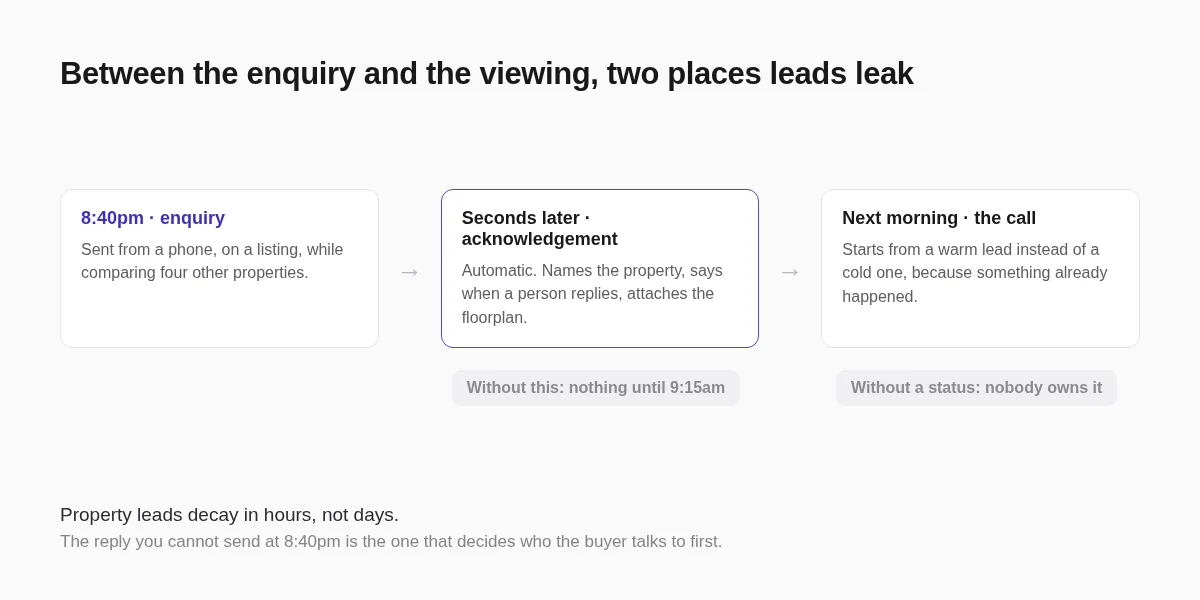
An enquiry arrives at 8:40pm. It is read the next morning at 9:15. By then the same person has enquired on four other properties, and two of those agencies replied the previous evening.
Nothing about that story is a website problem, but the website is where it is fixable.
Speed is most of the job
Property enquiries decay faster than almost any other kind of small-business lead, because the buyer is comparing several properties at once and the first useful reply anchors the conversation. An hour is good. The next morning is usually too late.
You cannot answer at 8:40pm every night. What you can do is make sure something useful happens at 8:40pm, and that the human reply the next morning starts from a warm lead rather than a cold one.
Ask for less than you want to know
Every extra field on an enquiry form costs you enquiries. The temptation on a property site is to qualify hard up front: budget, position in chain, mortgage in principle, preferred viewing times.
Ask for the name, the email, a phone number and a message. Everything else is a question for the reply, when you have someone who has already put their hand up. The one addition worth making is the type of enquiry, because "I want a viewing" and "what would you value my house at" are two completely different conversations and should not arrive in the same inbox looking identical.
Enquiries belong to a property and to a person
The mistake that costs the most is treating an enquiry as an email. An email is a dead end: it sits in one inbox, it is invisible to whoever picks up the phone next, and when the same buyer enquires again about a different property nobody knows.
An enquiry should be attached to two things at once. To the listing, so you can see that four people asked about the same flat and none of them booked, which is a pricing signal rather than a marketing one. And to the person, so their second and third enquiries land on the same record.
On a site built here, an enquiry is stored against the listing and linked to a contact record, which is the same record used by the rest of the site. The reasoning behind keeping one list rather than several is worth reading separately.
Route it where somebody is looking
Enquiries go to whichever address is set for them, and the trap is setting that to a personal mailbox belonging to whoever built the site. Two people leave the business and the enquiries quietly go to nobody.
Use an address more than one person reads. Then check it: send yourself an enquiry through the live form once a month. It takes a minute and it is the only way to find out that a mail change eight weeks ago has been dropping leads ever since.
Automate the acknowledgement, not the answer
An automatic reply is not a substitute for a person, and buyers can tell instantly. What it does is hold the lead for the hours you are not working.
A good acknowledgement confirms which property they asked about, says when a human will reply, and gives them something to do in the meantime: the floorplan, the brochure, the other two properties on the same street. A bad one says "we have received your message" and takes up space.
Because the platform fires an automation when a property enquiry is submitted, that reply is a rule you write once rather than a job somebody does. Email automations covers how the triggers are set up.
Keep a status on every enquiry
New, contacted, viewing booked, closed. Four states are enough, and the value is not the reporting. It is that "new" is a list somebody can clear, and an enquiry with no status is an enquiry nobody owns.
The weekly question worth asking is not how many enquiries came in. It is how many are still sitting in "new" from more than two days ago, because that number is money on the floor.
The pattern in the numbers
Once enquiries carry a listing and a status, two patterns show up quickly.
- Lots of enquiries, no viewings booked on a single property is a price or a photo problem, not a lead problem.
- Enquiries that never reach "contacted" at particular times of day tell you when your cover is thin, which is usually evenings and Sunday afternoons, which is exactly when people look at houses.
FAQ
How fast should I reply to a property enquiry?
Within the hour during working hours, and the same evening for anything that arrives before about 9pm. Buyers enquire on several properties at once and the first substantive reply usually sets the agenda for the rest of their search.
Should the enquiry form ask for a phone number?
Ask for it, but do not require it. Requiring a phone number measurably reduces the number of enquiries, and someone who will only give an email address is still a real lead. You can ask for the number in your reply.
What should an automatic acknowledgement say?
Which property they asked about, when a person will get back to them, and one useful thing they can do now, such as viewing the floorplan or the brochure. Avoid anything that reads as a final answer, because it invites them to keep looking elsewhere.
Do I need a separate form for valuation requests?
Not a separate form, but a way to tell the two apart. A valuation request and a viewing request go to different people and have different urgency, so capturing the enquiry type on the form is enough to route them properly.
Where this goes next
The enquiry side is part of the same module as the listings themselves, described on the estate agent and letting agent pages, with setup in property listings and settings.
If enquiries are arriving but they are junk rather than buyers, that is a different problem with its own fix.