
A small charity adds a donate button to its homepage and waits. Over the next month it takes four donations, all from trustees.
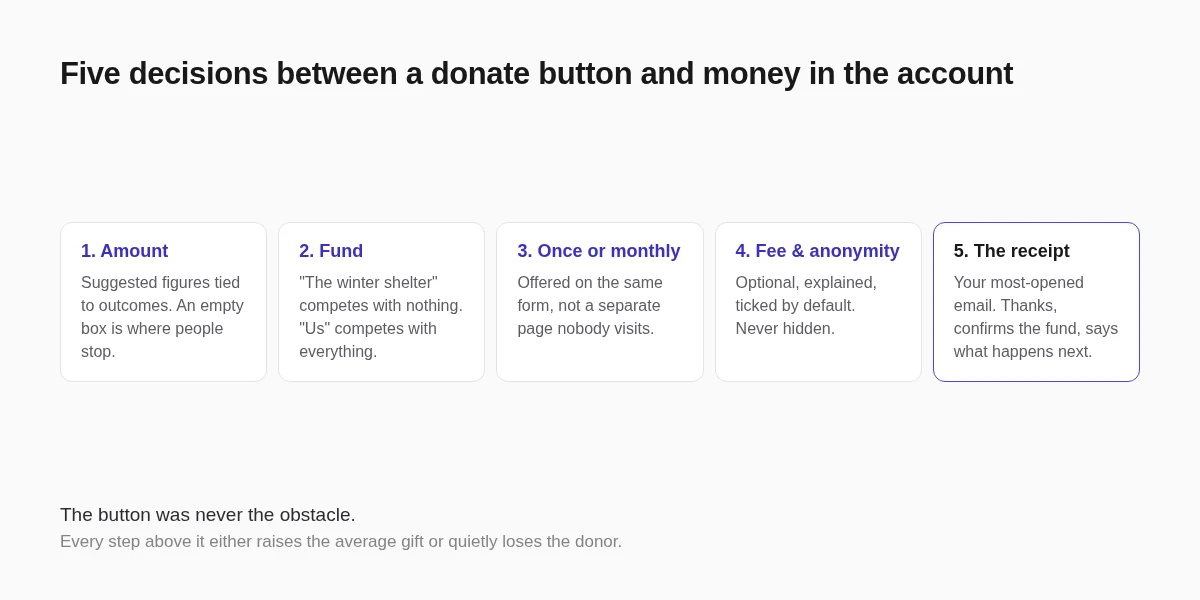
The button was never the obstacle. What decides how much arrives is everything around it: what amounts are offered, what the money is for, whether giving again requires the whole process a second time, and whether the receipt looks like it came from a real organisation.
Suggested amounts do most of the work
An empty amount box is a small maths problem in the middle of a generous impulse, and a meaningful share of people abandon at exactly that point.
Offer three or four amounts and let the middle one be the one you would like. Anchor them to something real: 10 pounds buys a week of feed, 25 pounds covers a session, 100 pounds funds a month. A donor giving to a specific outcome gives more than one giving to a category, and the difference is not small.
Keep a free-text option for the people who want to give something else, but do not lead with it.
Funds make giving specific
"Donate to us" competes with everything else in a donor's month. "Donate to the winter shelter" competes with nothing.
Splitting donations into a small number of funds does two things at once: it raises the average gift because the ask is concrete, and it lets you report back on that fund specifically, which is what produces the second donation. Two or three funds is plenty. A dozen turns a decision into a menu.
On a site built here funds are set up alongside a goal, so a page can show progress towards a target rather than an abstract total. Donation goals and funds covers the setup.
Recurring giving is the whole game
One-off donations pay for this month. Recurring donations are what let a small organisation plan, and the difference in lifetime value between the two is usually a factor of five or more.
The mechanics matter less than the framing. A monthly option presented as a choice on the same form, at an amount that looks small next to the one-off figure, converts far better than a separate "become a supporter" page that nobody visits. Ten pounds a month reads as easier than 120 pounds once, and it is.
Let donors cover the fee
Card processing takes a percentage of every donation. Offering donors the option to add it, with a checkbox that is on by default and clearly explained, is one of the few free wins in fundraising: most people tick it, nobody is misled, and the charity keeps the whole gift.
Two rules. Say plainly what the extra amount is for, and never make it compulsory or hidden. A donor who discovers an unexplained addition on their statement is a complaint and a lost supporter.
Anonymity and the donor wall
A public list of supporters is genuine social proof, and it also makes some people uncomfortable enough not to give at all.
Give donors the choice on the form: give anonymously, or appear on the wall. Both options need to be honoured everywhere, including in any report you publish later. A donor who ticked anonymous and then saw their name on a thank-you page will not give again.
The receipt is part of the fundraising
The confirmation email is the most-opened message your organisation ever sends, and most charities waste it on a bare transaction record.
It should confirm the amount and the fund, carry whatever your jurisdiction requires for tax purposes, thank the person like a human being, and say what happens next. Anything you want a donor to do second, from Gift Aid to sharing the appeal, belongs there rather than in a later email nobody opens. Donors and receipts covers what is sent and when.
Test with a real card
The single most common failure in online fundraising is a donate page that has quietly stopped working: an expired payment connection, a key rotated during an upgrade, a form that errors on mobile only.
Give your own organisation five pounds through the live page, on a phone, once a month. Check the money arrives, the receipt sends, the donor appears where they should and the total moves. It takes three minutes and it is the only way to find out before a supporter does.
FAQ
What is a good suggested donation amount?
Anchor the amounts to outcomes rather than round numbers, and set the middle option at what you would actually like to receive. Most organisations find three options plus a free-text box works better than either a single suggestion or a long list.
Should I ask donors to cover the processing fee?
Yes, as an optional and clearly labelled addition. Most donors accept it when it is explained, and it noticeably increases the amount you keep. It should never be compulsory or added without being visible before payment.
Is recurring giving worth setting up for a small charity?
It is usually the highest-value change available. A monthly donor at a modest amount is worth several times a one-off donor of the same size, and offering the option on the main donation form converts far better than a separate page.
Do donation receipts have to say anything specific?
Requirements vary by country, so check your own rules, but a receipt should always confirm the amount, the date, the organisation and what the donation was for. Where donors can claim tax relief, the receipt usually has to carry additional details.
Where this goes next
Setting up the payment side and the page itself is covered in set up donations, with funds and targets in donation goals and funds.
If the site itself is not built yet, how to make a nonprofit website covers the pages that need to exist around the donate button.