
"Your site scores 68." Compared to what, measured how, and which of the missing 32 points is worth your Saturday?
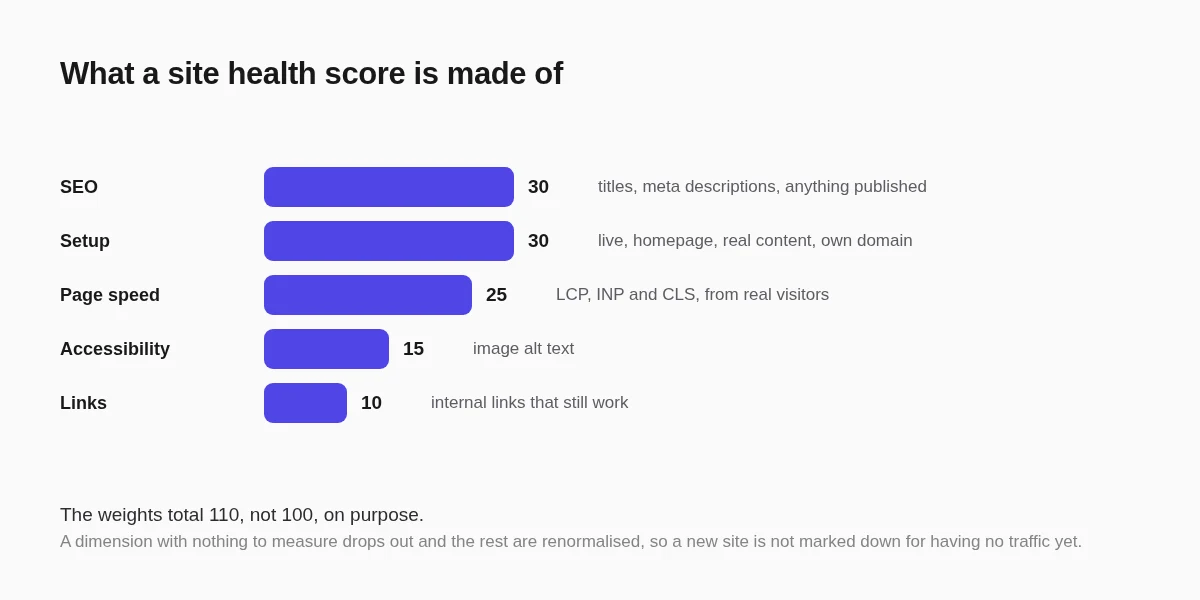
A health score is only useful if you can see inside it. A number with no breakdown is a number you cannot act on, and most of them are exactly that. So here is the anatomy of one, using the five dimensions the score on this platform is built from.
SEO, weighted 30
The heaviest single dimension, and the least glamorous. It is not about rankings, which no tool can promise. It checks whether the pages you have published are actually equipped to be found: does every page have a meta description, does it have a title written for search rather than inherited from the page name, and is anything published at all.
Meta descriptions do not affect ranking directly. They affect whether somebody clicks the result, which is the part you can control. A site with eight pages and two descriptions is leaving six results to be auto-generated from whatever text happens to be near the top.
Setup, weighted 30
The dimension people skip past, and the one that most often explains a bad score.
It asks whether the site is live at all, whether there is a homepage, whether there is more than one page of content, and whether a custom domain is connected. These sound trivial. They are also the four things that make the difference between a site that exists and a site that works: a single-page site on a free subdomain ranks and converts worse than the same content on its own domain with an About and a Contact page, and no amount of tuning elsewhere compensates.
Page speed, weighted 25
Measured from real visitors rather than a laboratory test, which is the important distinction. A synthetic test tells you how fast the site is on a machine in a data centre. Field data tells you how fast it was for the people who actually loaded it, on the phones and connections they actually have.
The three numbers are the ones Google uses:
- LCP, how long until the main thing on the page appears. Under 2.5 seconds is good.
- INP, how long the page takes to respond when someone taps or clicks. Under 200 milliseconds is good.
- CLS, how much the layout jumps while loading. Under 0.1 is good, and the usual cause of a bad number is images without dimensions.
Because it needs real visitors, this dimension has nothing to say on a new site. A score that drops out is not counted rather than counted as zero, which is why a brand-new site does not get punished for having no traffic yet. Website speed for small business covers the fixes.
Accessibility, weighted 15
Currently the most tractable dimension in the list, because it is dominated by one thing: whether your images have alt text.
Alt text is a sentence describing what the image shows. It is what a screen reader announces, what appears if the image fails to load, and one of the few things search engines can use to understand a picture. Writing it for a twelve-image site takes twenty minutes and moves this dimension from bad to full marks.
Describe the content, not the file: "A stylist finishing a client's cut at a mirrored station" rather than "salon photo 3". Decorative images that carry no meaning are the one exception and should have empty alt text rather than a description.
Links, weighted 10
The smallest weight and the fastest fix. It counts internal links that point at pages which no longer exist, usually because a page was renamed or deleted and something still links to the old one.
Broken internal links are worse than they look. They waste the crawl budget that gets your pages indexed, they dead-end visitors who were already interested enough to click, and they are invisible from the front page, so they persist for months.
How the weights actually behave
The weights add up to 110 rather than 100 on purpose. Any dimension with nothing to measure drops out and the rest are renormalised, so a new site with no visitor data is scored on the four dimensions that can be measured rather than being marked down for the one that cannot.
That has a practical consequence worth knowing: your score can fall the week you start getting traffic, because a dimension that was previously not counted has appeared. Nothing got worse. Something started being measured.
Which fix first
Ignore the score and read the list of fixes, in this order:
- Anything in Setup. Not published, no homepage, no domain. These are cheap and they gate everything else.
- Missing meta descriptions, on your most important pages first, not alphabetically.
- Alt text, because it is twenty minutes for a whole dimension.
- Broken links, because they take minutes and they are actively costing you.
- Page speed, last, because it is the only one that can require real work.
The order is deliberately not the order of the weights. It is the order of effort against effect.
FAQ
Is a website health score the same as a Google ranking?
No, and any tool implying otherwise is overselling. A health score measures whether your site is equipped to perform: whether it is published, described, fast, readable and internally consistent. Rankings depend on competition and content quality, which no score can see.
Why did my score go down when I did not change anything?
The usual reason is that a dimension started being measured. Page speed needs real visitor data, so it does not count on a new site, and it appears once traffic arrives. Adding pages can also lower a percentage-based dimension if the new pages lack descriptions or alt text.
What is a good score?
Above 80 is a site with nothing obviously wrong. Between 60 and 80 usually means one dimension is dragging, and it is normally missing meta descriptions or alt text. Below 60 almost always means something in setup, such as a site that was never actually published.
Does fixing alt text help SEO or accessibility?
Both, which is why it is the best value fix on the list. It is what screen readers announce, and it is one of the few signals search engines have about what an image contains.
Where this goes next
The score, its breakdown and the fix list are described in site health score.
For the SEO dimension specifically, SEO basics for beginners covers the underlying ideas, and what to measure on a small business website covers the numbers worth watching once the score is healthy.