
The site went live on Tuesday. It is Friday. Searching the business name returns a Facebook page, a directory listing from 2019 and somebody else entirely.
This is normal, and it is also sometimes a real fault. The useful thing is to know which, and the check takes about five minutes.
The one-line test
Search for site: followed by your domain, with no space: site:yourbusiness.com.
- Results come back. You are indexed. Your problem is ranking, not indexing, and it is a different article.
- Nothing comes back. Google has not indexed the site. Work down the list below in order, because they are sorted by how often each one is the cause.
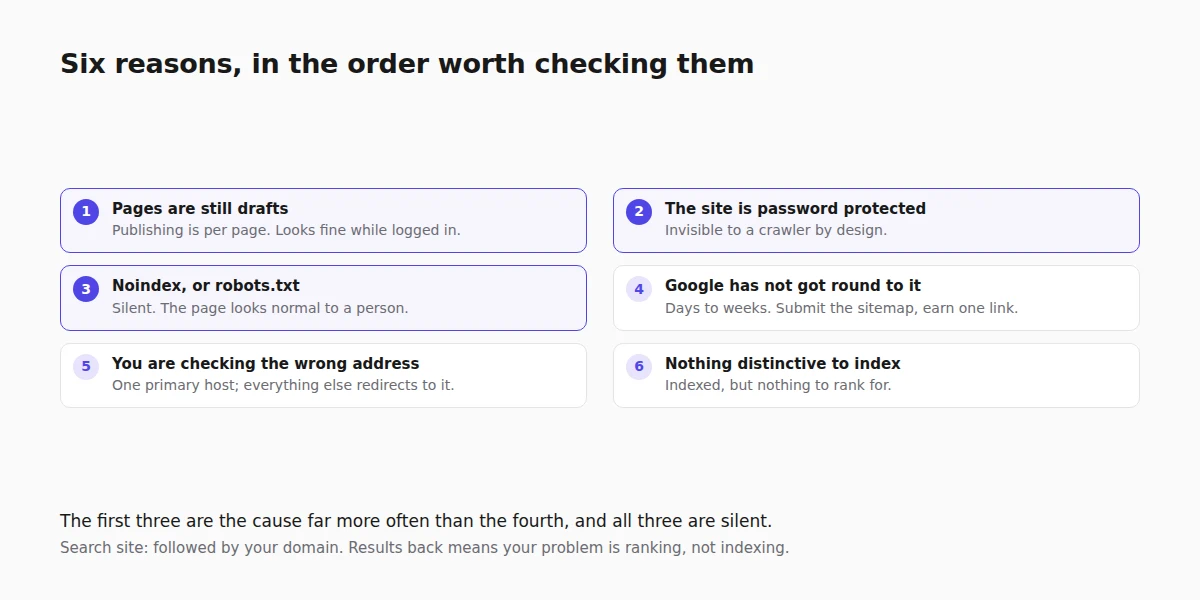
1. The pages are not published
The most common cause by a distance, and the least suspected. A page can be finished, look right in the builder, and still be a draft.
Publishing is per page. A homepage that went out while the About and Services pages stayed in draft gives you a one-page site, and it is easy to miss because everything looks correct while you are logged in. Check each page's state rather than trusting the preview, which is exactly what publishing your site walks through.
2. The whole site is set to private
Sites are often built behind a password so a client or a colleague can look without the public finding it, and then the password is never taken off.
A password-protected site is invisible to a crawler by design. If the site asks for a password in a private browser window, that is your answer. The visibility setting is described in site status and visibility.
3. Something is telling search engines to stay out
There are two switches with a big effect, and both are silent.
A page can be marked "do not index", which is right for a thank-you page and wrong for a services page. It can also be excluded from the sitemap. Neither shows up in a browser and the page looks perfectly normal to a human visitor.
The site-wide equivalent lives in a file called robots.txt. Visit yourdomain.com/robots.txt and read it. If it disallows everything, nothing else you do matters.
Worth knowing: an unclaimed preview site is deliberately kept out of search until it is a real site, so a preview URL not appearing is the system working rather than failing.
4. Google has not got round to it yet
Once the first three are ruled out, this is usually the answer, and the honest range is days to a few weeks for a new domain with no history.
Two things speed it up, and neither is a trick:
- Submit the sitemap. Your site publishes one at
/sitemap.xml. Register the site in Google Search Console and give it that address, which turns "eventually discovered" into "told about it directly". - Get one real link. A crawler finds new sites by following links. Your Google Business Profile, an industry directory, a supplier's stockist page, a local association. One genuine link does more than fifty submissions.
5. Your address is not the address you are checking
Every site here has one canonical home. If a project is on a custom domain, that is the primary host, and anything else pointing at the same site redirects there permanently rather than serving a duplicate copy.
This is what you want, because two addresses serving the same content is a classic way to split your own signals. But it does mean searching for the wrong address returns nothing while the site is perfectly well indexed on the right one. Check the address that appears in the browser bar after the page has loaded, not the one you typed. If you have recently moved, moving a website without losing rankings covers what should have happened.
6. There is nothing distinctive to index
A site of four pages saying what every competitor says gives a search engine no reason to prefer it. It will get indexed and it will not appear for anything except your own name.
That is not an indexing fault, and it is not fixed by resubmitting. It is fixed by having pages that answer specific questions with specific facts: prices, areas covered, hours, what is included. That is the same material assistants need in order to quote you, which is the argument in getting quoted by AI search, and the fundamentals sit in SEO basics for beginners.
While you wait, do the thing that works fastest
For a local business, the fastest route to being findable is not Google's index of your website at all. It is your Google Business Profile, which can appear in local results within days and which you control completely.
Fill it in properly, make the name, address and phone number identical to the ones on your site, and link it to the site. That consistency is also the strongest local ranking signal you have, and it is covered in local SEO for a one-location business.
A quick self-check before you ask anyone else
Run these in order and you will have found the cause or ruled out everything cheap:
site:yourdomain.comin Google.- Open the site in a private window. Does it load without a password.
- Visit
/robots.txtand read it. - Visit
/sitemap.xmland check your pages are listed. - Check each page is published, not draft.
- Confirm the address in the browser bar is the one you expect.
If all six pass and it has been under three weeks, the answer is time. The site health score will tell you whether anything else on the technical side needs attention while you wait, and site is blank, missing or out of date covers the cases where the page itself is wrong.
FAQ
How long does Google take to index a new website?
Typically a few days to a few weeks for a new domain with no history. Submitting a sitemap in Search Console and earning one real inbound link are the two things that reliably shorten it.
Do I have to pay to be in Google's results?
No. Organic indexing is free. Paid ads are a separate product and buying them does not affect whether or how your pages are indexed.
Why does my site appear for my business name but nothing else?
That is normal for a new site and it means indexing is working. Ranking for anything competitive takes content that answers specific questions and time for that content to accumulate signals.
What is a sitemap and do I need to submit it?
A machine-readable list of your pages, published automatically at /sitemap.xml. Submitting it in Search Console is not required but it is the single easiest thing you can do to be found sooner.
I moved my site to a new domain and the old one still shows. Why?
Search engines take time to transfer the old address to the new one, and that transfer depends on permanent redirects being in place. If your old URLs redirect correctly, the results follow within weeks.