
Somebody asks an assistant where to hire a van in Leeds at short notice. It answers in a paragraph and names two or three businesses.
There is no ranking to check and no position to report. You were either quoted or you were not. That sounds like a new game, and the useful news is that it mostly is not: the pages that get quoted are the pages that were already clear, factual and easy to read. What changes is which parts matter most.
How an assistant decides what to quote
Strip away the detail and the process is: find pages that look relevant, read them, and reuse the parts that answer the question directly and can be stated without hedging.
Three consequences follow, and they are the whole strategy.
- It must be able to read your page. Content that only exists inside an image, or that only appears after a click, is content that cannot be quoted.
- It quotes answers, not brochures. A sentence that directly answers a question is quotable. A paragraph of positioning is not.
- It needs facts it can state. Prices, areas covered, opening hours, what is included. Vagueness is unquotable by construction.
Answer the question in the first two sentences
The single highest-value change on most small business pages.
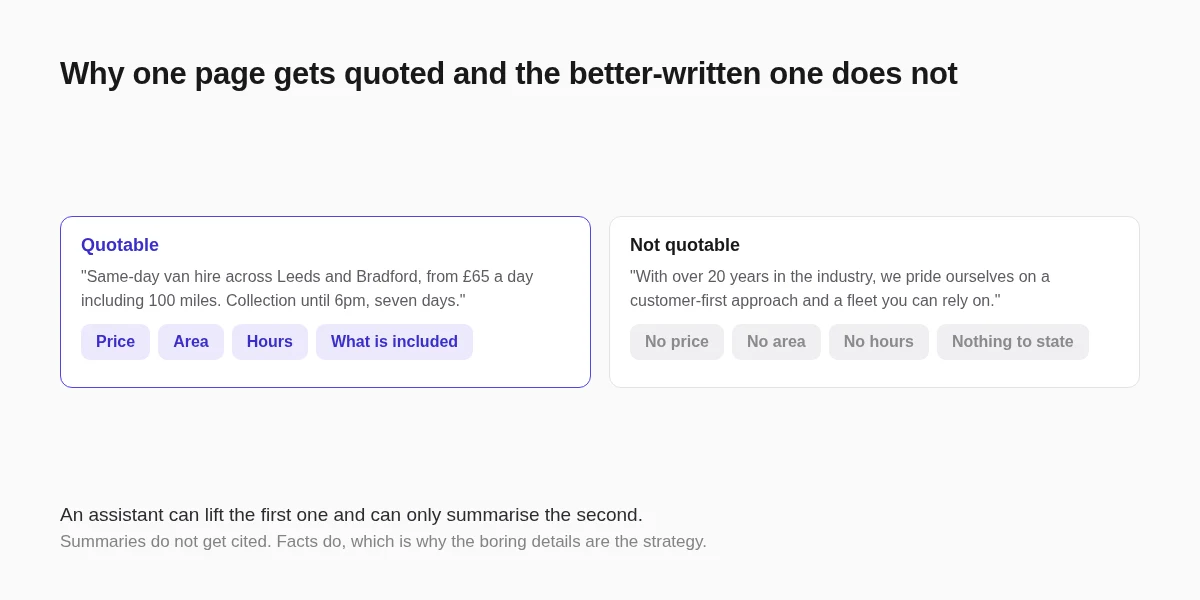
If a page is about emergency van hire, the first two sentences should say what it costs, what area it covers and how fast it can happen. Not the history of the company, not "we pride ourselves". An assistant reading that page can quote the first version and can only summarise the second, and summaries do not get cited.
This is the same discipline as writing a good opening for a human reader, which is why pages that do it tend to do better in both places at once. Writing website copy that converts covers the human half.
Put the boring facts in writing
The questions people ask assistants about small businesses are overwhelmingly logistical: are you open on Sunday, do you deliver to this postcode, how much is it, do you take dogs, where do I park.
Every one of those has a factual answer that most sites leave to a phone call. Writing them down is not glamorous and it is the difference between being quotable and being invisible:
- Opening hours, as text, including the exceptions.
- The area you actually cover, named.
- Prices, or an honest range, or at minimum what determines the price.
- What is included and what is not.
- How to reach a human, and when.
Structured data does the disambiguating
Structured data is a block of machine-readable JSON describing what the page already says. It does not make you rank and it does not make you quoted. What it does is remove ambiguity: this string is an address, this number is a price, these are opening hours rather than a phone number.
On a site built here, some of it is already generated from what you have entered. The homepage carries business markup built from your business details, including the postal address and opening hours, alongside site-level markup and breadcrumbs. Shop product pages carry product and offer markup with the price and availability. Blog posts that use a question-and-answer section carry FAQ markup automatically.
What is not automatic is the underlying accuracy. Markup generated from empty business details describes nothing, which is why business details is worth ten minutes. The general subject is covered in structured data for small business websites.
A page has to be reachable to be read
Obvious, and the most common silent failure.
- Be published and crawlable. A staging site with indexing switched off cannot be quoted.
- Be in the sitemap, so new pages are found rather than stumbled upon.
- Load without JavaScript doing the work. If the text only appears after scripts run, assume some readers never see it.
- Do not hide the answer behind a tab or an accordion on a page whose whole purpose is that answer.
Write the questions down as questions
An FAQ section that uses the actual phrasing people use is the highest-yield format for this, for a simple reason: the question in the heading matches the question being asked, and the answer beneath it is self-contained.
That is also why the answers should not depend on the paragraph above them. Each one is likely to be read alone, and an answer starting "as mentioned above" cannot be quoted by anything.
Two or three real questions per page beats a bank of twenty invented ones. Take them from your own inbox and your own phone.
What not to bother with
- Keyword stuffing. It was already ineffective for search and it makes text less quotable, not more.
- Publishing thin pages at volume. More pages of nothing is not more surface area.
- Chasing every new file convention. Conventions for declaring content to assistants are still unsettled, and none of them substitutes for a clear, crawlable page.
- Claiming things you cannot support. An assistant quoting a false claim about your business is a worse outcome than not being quoted.
FAQ
Is being quoted by AI different from ranking on Google?
The mechanics differ but the inputs overlap heavily. Both reward pages that are crawlable, clearly written and factual. The main difference is that assistants prefer self-contained answers they can lift, so a page that answers a question directly has an advantage over one that requires reading in order.
Does structured data make an assistant quote my page?
No. It removes ambiguity about what your facts mean, which makes a page easier to use correctly. The quoting decision is driven by whether the page answers the question, in text, in a way that can be stated plainly.
Do I need a separate page for every question people ask?
No, and it usually backfires. A small number of strong pages with genuine question-and-answer sections works better than many thin pages, because each answer still needs to be self-contained but the page around it needs to be substantial enough to be worth reading.
Should I block AI crawlers from my site?
That depends on whether you want to be quoted. For a small business trying to be found, blocking the crawlers that feed assistants removes you from the answers. For a business whose content is the product, the calculation is different.
Where this goes next
The markup side is covered in structured data for small business websites, and the facts that feed it live in business details.
For the fundamentals underneath both, SEO basics for beginners is the place to start.