
Traffic doubled after the summer push. Orders did not move. The obvious conclusion is that the traffic was the wrong traffic, and sometimes it is, but far more often the traffic was fine and something between arriving and paying quietly ate it.
Total visits cannot tell you which. A funnel can, and it is the difference between "the website needs work" and "the delivery options page loses two thirds of the people who reach it".
A funnel is just an ordered list of steps
Nothing more complicated than that: the pages or actions somebody passes through on the way to the thing you want, in order, counted at each stage.
A shop might be: product page, add to cart, checkout, payment complete. A service business: services page, contact form, form submitted. A rental: item page, dates chosen, reservation confirmed.
The value is entirely in the gaps between steps. One number tells you nothing. Four numbers in sequence tell you exactly where to look.
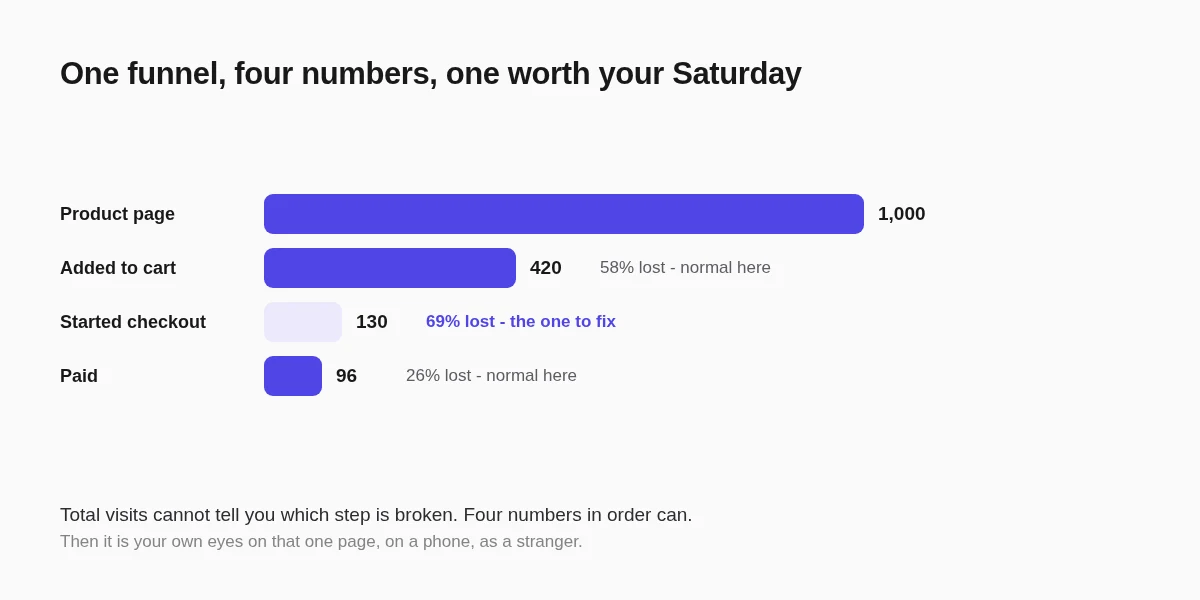
Read the gaps, not the total
Some drop-off is normal and some is a bug wearing a costume. The gaps tell you which:
- A big drop from landing to the next step usually means expectation mismatch. People arrived expecting something else, which is a campaign or a search-result problem rather than a page problem.
- A big drop at the cart or the form is usually cost, effort or trust. Unexpected delivery charges, a form with fourteen fields, no visible contact details.
- A big drop at payment is a technical suspect first. Test it on a real phone before rewriting any copy.
- An even trickle across every step is normally speed or mobile layout, which affects everything uniformly rather than one page.
Define the funnel narrowly
The most common mistake is a funnel with nine steps that describes an ideal customer journey nobody actually takes. It produces a chart that always looks bad and never says why.
Three or four steps is right. Start at the point where intent is clear, not at the homepage: somebody on the homepage may be looking for your phone number, and counting them as a failed purchase makes every number meaningless.
Name it after the question you are asking. "Checkout, October" is a funnel you will read. "Main funnel" is one you will not.
What to do with the answer
The point of finding the leaking step is that it makes the next decision cheap.
- Look at it on a phone, on mobile data, as a stranger. Most drop-offs are visible within thirty seconds of doing this.
- Count the fields and the clicks. Every one is a chance to leave.
- Check what it costs to get to the next step. Unexpected charges appearing late is the most reliable cart-killer there is.
- Check it loads. A step that takes six seconds on a phone loses people who never intended to leave. That is a fixable problem.
- Change one thing, then look again in a fortnight. Two changes at once and you have learned nothing.
Small numbers lie
A funnel over 40 visits is noise. One extra sale moves a percentage several points and you will convince yourself of something untrue.
Wait for a few hundred people to enter the funnel, or widen the date range until you have them. If your site never sees a few hundred, the honest answer is that the drop-off is not your constraint yet and the traffic is, which is a different job.
What a funnel will not tell you
It shows you where, never why. It cannot see that the delivery estimate says nine days, or that the size guide opens a broken link, or that the photo makes the product look grey.
The sequence that works is: funnel to find the step, then your own eyes on that step, then one change. Analytics narrows the search. It does not do the looking.
FAQ
How many steps should a funnel have?
Three or four for most small sites. Longer funnels describe a journey nobody takes literally and produce charts that cannot be acted on. Start at the point where intent is clear rather than at the homepage.
What is a normal drop-off rate between steps?
It varies far too much by industry to give a useful benchmark, which is why the number to watch is your own over time rather than somebody else's average. A step that suddenly gets worse is worth more attention than one that has always been mediocre.
Why is my funnel showing more completions than starts?
Usually because people can enter partway through, for example by returning to a saved cart or arriving on a checkout link directly. It is a sign the first step is defined too narrowly rather than a counting error.
How long should I wait before judging a change?
Until a few hundred people have entered the funnel since the change, which on a small site is often two to four weeks. Judging after a weekend is how businesses talk themselves into reverting improvements.
Where this goes next
Setting up and reading funnels is covered in conversion funnels, with the surrounding numbers in the analytics dashboard.
For which metrics deserve attention in the first place, what to measure on a small business website is the companion piece.