
A one-location business is competing for a few hundred searches a month from people who are already nearby and already intending to buy something. That is the easiest search traffic there is, and most small sites lose it to businesses with worse websites and better-maintained details.
None of this requires a content strategy. It requires being unambiguous about who and where you are, in the four or five places that matter.
Your details have to match everywhere
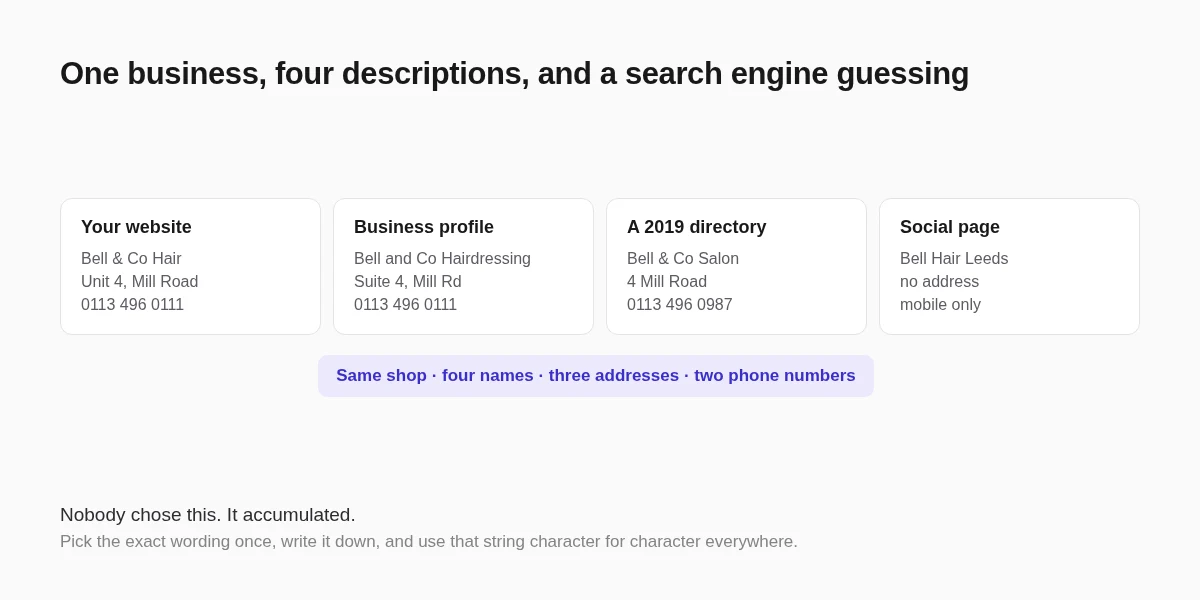
Name, address, phone number. The same three facts appear on your website, your business profile, your social pages, directories and whatever listing somebody made for you in 2019.
When they disagree, and they usually do, every consumer of that data has to guess which version is right. "Suite 4" on one and "Unit 4" on another, an old landline in one directory, a trading name in one place and a registered name in another.
Pick the exact wording once. Write it down. Use that string everywhere, character for character, and fix the old entries when you find them.
The business profile does most of the work
For local searches the map result is often more valuable than the website result, and it is driven by a profile you control and can update in an afternoon.
The parts that matter most, roughly in order:
- The right primary category. This is the biggest single lever and the one most often set carelessly. "Hair salon" and "beauty salon" surface for different searches.
- Hours that are true, including holidays. Wrong hours produce a specific and lasting kind of anger.
- Real photographs, updated occasionally. Not stock, and not only the exterior.
- Reviews, and replies to them.
- Services or products listed, because those become searchable text.
One real location page
Your website should have a page that a human would recognise as being about your location: the address as text rather than only in an image, the hours, parking, public transport, what the building looks like, and a map.
The phrase to write naturally is the one people actually search, which is normally the service plus the place. Write it the way a person says it, once in the page title and once or twice in the text, and stop there. Repeating it eleven times is the oldest bad advice in the field.
If you have exactly one location, resist the urge to create pages for every surrounding town. Search engines have been discounting thin near-duplicate location pages for a decade, and a business with one shop and fourteen town pages looks like exactly what it is.
Make the facts machine-readable
Search engines and assistants both do better when the address, hours and contact details are structured data rather than something to be inferred from a paragraph.
On a site built here, the homepage emits business markup generated from your business details, including the postal address and opening hours, so filling those in properly does double duty: it appears on the site and it feeds the markup. That takes ten minutes in business details and is the highest-value ten minutes in this article.
Reviews are local ranking and local persuasion
Reviews affect what shows in the map results and they are the deciding factor for a person choosing between two similar businesses.
The mechanics are unglamorous: ask, at the moment the customer is happiest, and make it one tap. Do not offer incentives, do not bulk-request from old customers, and reply to the bad ones without arguing. How to get more customer reviews covers the timing, which is most of it.
The things that actually move a small local site
In order of effect per hour spent:
- Fix the details so they match everywhere.
- Complete and correct the business profile, especially the primary category.
- Write one honest location page with the address as text.
- Get a steady trickle of reviews, forever, rather than twelve in one week.
- Make sure the site loads quickly on a phone, because most local searches are on one.
- Get listed in the two or three directories that matter in your trade, and ignore the rest.
That is the whole list. There is no seventh item that changes the outcome, and most of the services sold to small businesses under the local SEO heading are variations on items one and six with a monthly fee attached.
FAQ
Do I need a separate page for every town near me?
No. Thin pages that differ only by place name have been discounted for years and can make a site look manipulative. One strong location page, plus genuinely different content if you truly operate differently in another town, is the safe and effective version.
How important is the business profile compared with my website?
For local searches, often more important, because the map result appears above the ordinary results and answers the question without a click. The website still matters for everything else, and the two should agree with each other exactly.
Do reviews affect local ranking, or only persuasion?
Both, and they are difficult to separate. Reviews feed the local results directly, and they are also what somebody reads when choosing between two listings that rank alike. A listing losing on both counts is usually short of recent reviews rather than short of total ones.
Does my address need to appear on every page?
The footer is the usual place, and it is enough. What matters more is that it appears as selectable text somewhere rather than only inside an image, and that it matches your other listings word for word.
Where this goes next
The details that feed both your site and its markup are set in business details, and the markup itself is explained in structured data for small business websites.
For a worked example in one trade, local SEO for a medical practice applies the same method with the constraints of a clinic.
Read next
- How to make a trade business website - local search is most of the marketing for a trade, so the site has to be built for it.