
Most small businesses think about email as campaigns: the newsletter, the sale, the thing you sit down and write. Those are the hard ones to do well and the easy ones to skip.
The emails that reliably earn their place are the ones nobody writes twice. Something happens, a message goes out. They are opened at rates a campaign never reaches, because they arrive when the person is thinking about you.
Why triggered beats scheduled
A newsletter arrives when you decided to send it. A triggered email arrives seconds after the recipient did something, which means their attention is already on the subject.
The difference in engagement is not subtle. Transactional and triggered messages routinely see open rates several times higher than a broadcast to the same list. If you only have time to set up one kind of email, set up this kind.
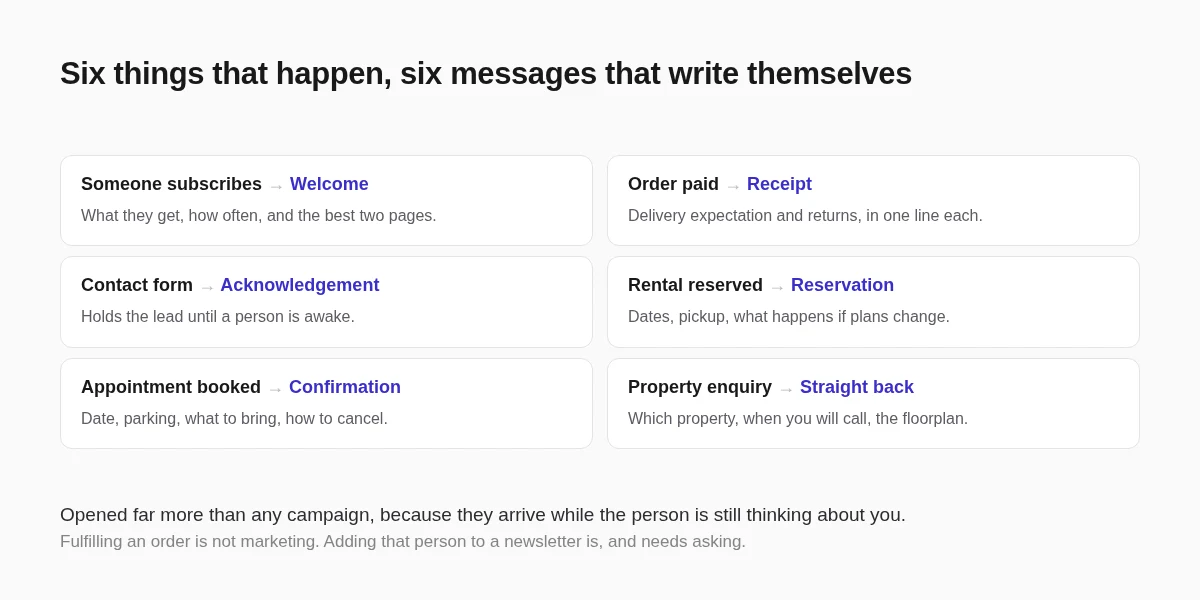
The six triggers worth having
These are the six moments a small business site actually generates, and what each message should do.
Someone subscribes
The welcome email. It is opened more than anything else you will ever send, and most businesses waste it on "thanks for subscribing".
Say what they will get and how often, give them the one thing that made subscribing worth it, and point at your two or three best pages. If there is a first-order incentive, this is where it lives, not in a later message.
Someone submits a contact form
The acknowledgement. Its job is to hold the lead during the hours you are not working: confirm what they asked, say when a person will reply, and give them something useful in the meantime.
Do not let it read as the final answer. A message that sounds complete invites the reader to carry on shopping elsewhere.
Someone books an appointment
The confirmation, and it is doing more work than it looks. It confirms the date and time in a form they can find again, it reduces no-shows simply by existing, and it is the natural place to put whatever the customer needs to know beforehand: where to park, what to bring, how to cancel.
The cancellation link is not a risk. A customer who cancels three days out is worth far more than one who does not turn up, because the slot is recoverable. That logic is the same as the one behind booking deposits.
Someone pays for an order
The receipt. The most-opened email in commerce, and usually the most wasted.
It has to carry the transaction detail. It can also carry the delivery expectation, the returns policy in one sentence, and one relevant next step. What it should not carry is a discount code for the thing they just bought at full price.
Someone reserves a rental item
The reservation confirmation, which on a hire business replaces a phone call. Dates, item, pickup point, what to bring, what happens if plans change. Rentals generate more pre-arrival questions than almost any other kind of booking, and each one answered here is a message you do not have to answer by hand.
Someone enquires about a property
The property acknowledgement. Property leads decay faster than most, and the buyer has usually enquired on several places at once, so the message that arrives within seconds is doing real work. Confirm which property, say when somebody will call, and attach the floorplan or brochure. There is more on that here.
What every triggered email needs
- A subject line that says what it is. "Your booking on Thursday at 2pm" beats "Thank you".
- The detail restated. People search their inbox for these. Put the date, the item and the amount in the body.
- One next step, at most. Two calls to action means neither happens.
- A real reply-to address. A no-reply address on a booking confirmation is a customer service failure with a stamp on it.
- Plain language. These are not marketing emails and they should not read like them.
The mistake that quietly breaks all of it
Triggered emails are, by definition, sent to people who did not opt into marketing. That is legitimate: an order receipt is part of fulfilling the order.
It stops being legitimate the moment you attach a marketing list to the trigger without asking. Adding someone to a newsletter because they booked an appointment is the single most common way small businesses acquire complaints and damage their sending reputation. If you want to grow the list from these moments, ask on the form, and let the answer decide.
Sending reputation is cumulative and slow to repair, which is why this matters more than it seems. Email deliverability for small business covers what actually happens when it goes wrong.
Set them up once, then test them once a quarter
The failure mode of automation is silence. A triggered email that stopped sending produces no error anybody sees, and it is normally discovered by a customer.
Once a quarter, run through the triggers you have live: make a booking, place a small order, submit your own contact form. Confirm each message arrives, in a reasonable time, with the right detail, and not in a spam folder.
FAQ
Do automated emails need marketing consent?
Messages that are part of fulfilling something the customer asked for, such as an order receipt or a booking confirmation, are not marketing and do not require marketing consent. Adding those people to a newsletter does, and the two must not be blurred.
How many automated emails should a small business have?
As many as it has real triggers, which is usually between two and six. There is no value in inventing sequences: each message should correspond to something the customer actually did.
Should a confirmation email include a cancellation link?
Yes. A cancellation three days ahead is a recoverable slot, and a no-show is not. Making cancellation easy reduces no-shows rather than increasing them, because the alternative is not turning up.
What is the best time to send a triggered email?
Immediately. The entire advantage of a triggered message is that it arrives while the person is still thinking about the thing they just did, so any delay you add is value you are giving away.
Where this goes next
The triggers, and how to build a message for each, are covered in email automations. For the campaign side, sending a campaign and email marketing for beginners are the starting points.