
10 questions to ask a web designer

Ask these before you pay a deposit. For each one: what a good answer sounds like, and what it costs you later when the answer is vague.

We make a website builder, so we are hardly neutral. The questions below are the ones worth asking whoever builds your site, including if that turns out to be us - there is one section at the end about doing it yourself, and it says who should not. Still deciding whether to hire anyone? The cost side, year one and year two, is set out in builder vs designer.

1 If we stop working together, what do I keep?

What a good answer sounds like

A good answer names three things separately: the domain, the content, and the site itself. The domain should be registered in YOUR name with YOUR card, on an account you can log into today - ask them to prove it while they are sitting there. The content - your copy, your photographs - should be yours in writing.

What a vague one costs

The common version of this going wrong is not malice. A designer registers the domain on their own account because it was quicker, then they retire, change business, or stop answering email, and the address customers have been typing for six years belongs to somebody unreachable.

Be sceptical of anyone, including us, who tells you a finished website is fully portable. Content and data usually are. The built site rarely is: a site made on a hosted builder, ours included, does not come out as a working website you can host somewhere else. Webkio exports your data - contacts, orders, bookings, subscribers - and not your pages. Plan for the domain and the content to move, and expect the build to be redone.

2 Who is writing the words?

What a good answer sounds like

Someone should say, out loud, that this is their job or yours. If it is yours, ask when they need it by and in what form, because a half-finished site waiting on your copy is the most common reason a project stalls for months.

What a vague one costs

The usual outcome is a beautiful site launched with placeholder text, or with the three sentences you dashed off at eleven at night. Design is quick to judge and copy is not, so it is the half that quietly gets skipped.

If you are writing it yourself, write the page nobody enjoys first - the one that says what you do and what it costs. Everything else is easier afterwards.

3 Can I change the opening hours myself, at nine on a Sunday?

What a good answer sounds like

A yes, followed by a demonstration. Ask them to show you the screen where you would do it, not describe it.

What a vague one costs

Every small change becomes an email and an invoice, so small changes stop happening. Within a year the prices are wrong, the hours are wrong, and the site is actively misleading the people it was built to attract.

This is the question that separates a website from a leaflet. If the honest answer is no, decide in advance who you will email and how fast they answer - and get that in writing too.

4 Is this a fixed price, and what is outside it?

What a good answer sounds like

A fixed number for a defined scope, with a written list of what counts as extra and what it costs. Hourly is fine too, with an estimate and a point at which they stop and check with you.

What a vague one costs

The gap between "a website" and "the website you pictured" is where every overrun lives. Without a scope on paper, both sides are sure they agreed something different.

Ask what happens if you hate the first draft. The answer tells you more about how they work than the price does.

5 How many rounds of changes are included?

What a good answer sounds like

A number, and what a round means. Two rounds where a round is "all your comments at once" is a normal, workable arrangement.

What a vague one costs

Unlimited revisions sound generous and usually are not: they are either priced in already, or they end in an awkward conversation when you have used more than the designer expected.

Save your feedback up and send it in one go. Dripping it out in messages is how two rounds becomes nine without anybody deciding to do that.

6 Can I see it on my own phone before we launch?

What a good answer sounds like

A link you can open on your phone, during the meeting, on your own network. Not a picture of a phone on a slide.

What a vague one costs

Most of your visitors will arrive on a phone. A design signed off on a large screen can be unusable on a small one, and the first person to notice should not be a customer.

Try it one-handed, outdoors, on mobile data. That is the real test, and it fails more sites than any checklist.

7 Can it take a booking, an order or a deposit?

What a good answer sounds like

If you need that, they should say what it uses, what it costs per transaction, and whose account the money lands in. If you do not need it yet, ask what adding it later would involve.

What a vague one costs

Retrofitting bookings or payments onto a brochure site is often a rebuild, not an addition. This is the question people most often skip and most often regret.

Whoever builds it, insist the money arrives in an account in your name. If payments route through somebody else first, you are relying on them to pass it on.
8 What happens after launch, and what does it cost a year?

What a good answer sounds like

A plain figure covering hosting, the domain renewal, any licences, and their time. Ask what is NOT covered.

What a vague one costs

A site with nobody maintaining it quietly breaks: certificates expire, plugins go stale, a form stops sending and nobody finds out until a customer mentions they emailed twice.

Put the domain renewal date in your own calendar regardless of who manages it. It is the single cheapest thing you can do to protect what you paid for.

9 What will make this show up on Google, and when?

What a good answer sounds like

Caution. A good answer covers the basics - every page has a title, the site is fast, the business details match Google Business Profile - and then says ranking takes months and depends on competition.

What a vague one costs

Anyone promising first place on a timeline is either guessing or selling. Nobody can promise a position, and the ones who do tend to buy links that cause problems later.

Ask what they will do in the first month, not what rank they will reach. And ask who gets access to the Search Console property - it should be you.

10 What do you need from me, and by when?

What a good answer sounds like

A short list with dates: logo files, photographs, copy, access to the domain. The good ones ask for this before you ask them.

What a vague one costs

Most projects that run late are waiting on the customer, not the designer - but nobody said so at the start, so it feels like the designer is slow.

Gather the photographs before you start. It is the item that delays things most often and the one you can do tonight.

And if you are thinking of doing it yourself

This is the part where we have an interest, so take it accordingly.

Building it yourself answers questions 1, 3 and 5 outright: the domain and the content are yours, you can change the opening hours on a Sunday, and there are no revision rounds because there is nobody to revise with. It does not answer question 2 - somebody still has to write the words, and that somebody is you.

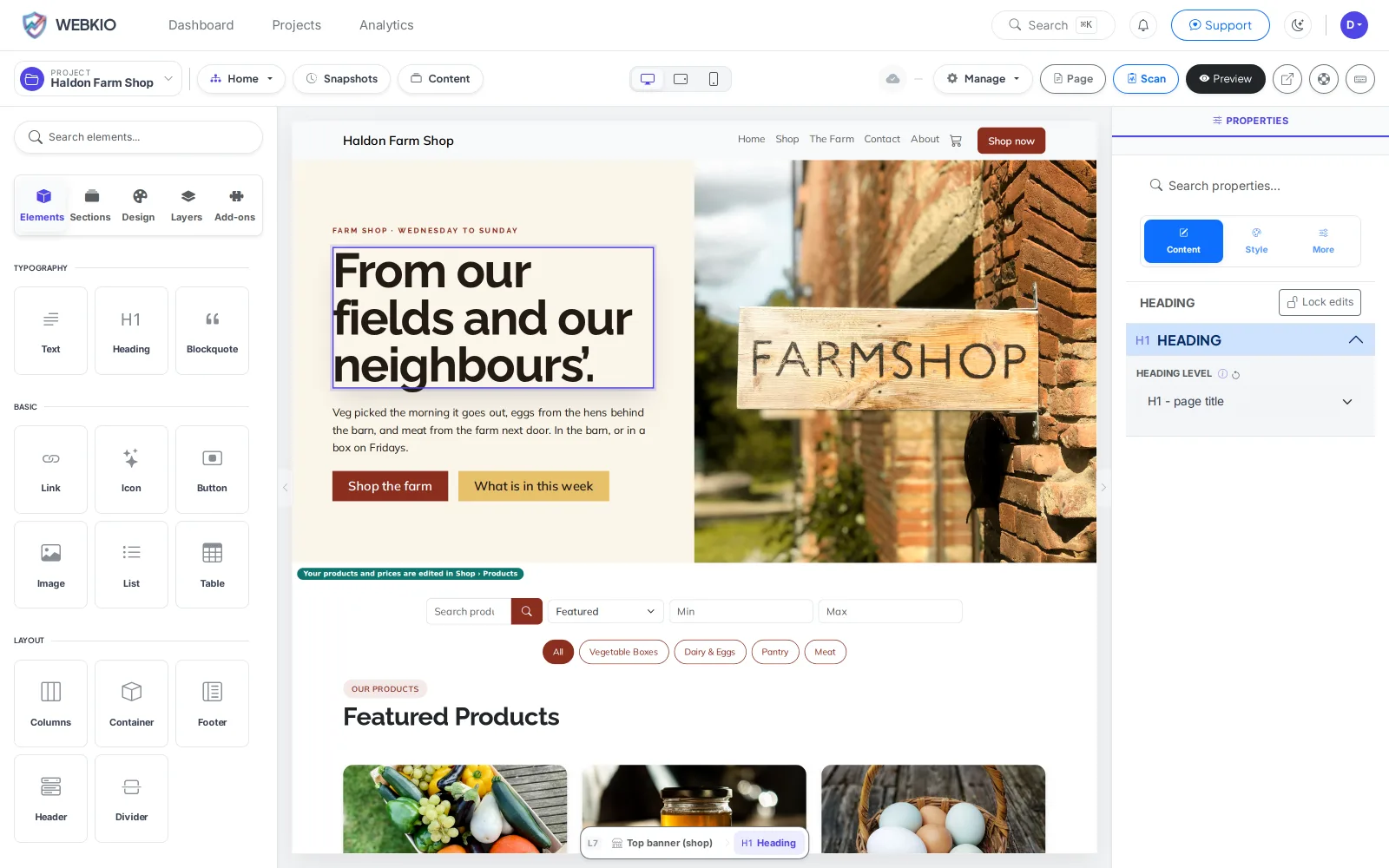
The Webkio editor with a heading selected and its settings open beside it
Editing a page in Webkio. This is the screen that answers question 3.

Do not do it yourself if your site needs something genuinely bespoke, if you would rather pay to have it off your desk, or if you know you will not come back to update it. A designer who maintains your site beats a builder you abandon after a month.