For car and van rental businesses - with a working reservations engine included. The fleet, live availability search and booking flow are provisioned on day one; you swap in your own vehicles.
Make it yours
Replace the demo fleet with your real vehicles (photos, transmission, seats, daily rate), set pickup locations and hours in the rental settings, and state deposit, insurance and mileage terms on the booking path. Airport/station pickup deserves its own mention if you offer it.
What a Car Rental Website Needs to Do
A rental site has a job the brochure sites in other trades do not: it has to answer "is this car free on those dates, and what does it cost" without anybody picking up the phone. Everything below follows from that.
The booking path is the product
Dates first, then the vehicles actually free for them, then a total the customer can act on. Every extra screen between those three steps costs reservations, and the ones lost are from people who had already decided to rent. This template arrives with that path in place: the fleet, live availability search and the reservation flow are provisioned on day one, so the work is swapping in your own vehicles rather than building the mechanism. The longer argument is in turning website visitors into bookings.
Your rules, not a generic calendar
Availability is only worth publishing when it reflects how the business actually runs. The rental settings behind this template carry the constraints a hire company works to:
Pickup locations, business hours and closed dates
A minimum notice period and a same-day cutoff, so nothing arrives for a pickup you cannot service
Turnaround buffers between one rental ending and the next starting
Seasonal rates, with weekly and monthly discounts
Mileage either unlimited or capped with an overage rate
Deposits, young-driver and additional-driver fees, one-way fees and a fuel policy
Set once, then applied to every quote the site produces. The car rental booking system page covers the same ground as a product rather than as a template.
Pricing that answers the question being asked
A daily rate is not a price. Somebody comparing two companies wants the total for their dates, with the refundable deposit shown separately, and the site that makes them ask usually loses to the one that did the arithmetic. What vague pricing costs is set out in unclear pricing and lost bookings.
Built for a phone first
Rental searches happen on phones, frequently mid-journey. The date picker, the fleet listing and the checkout are where a mobile layout fails first, which makes them the three worth testing before launch rather than after. How a bad mobile website costs bookings covers what to check.
Credibility for a company nobody has heard of
An independent operator competes against brands the customer already recognises. Photographs of your actual vehicles, named pickup points, deposit and insurance terms stated before checkout and a confirmation that arrives immediately do more for that gap than design polish does. Building trust on a rental website has the rest.
Replace the demo fleet with your own vehicles, set your locations and hours, and the site is a working reservation channel rather than a brochure with a phone number on it.
Questions and answers
Is the Car Rental template free?
Yes - you can start building and customizing the Car Rental template for free. The Rentals features need a paid plan (included in Starter), and the 14-day Starter free trial covers everything in this template.
What pages does the Car Rental template include?
It comes with 5 ready-made pages: Home, Fleet, About, Manage Reservation, Contact.
What can the Car Rental template do?
It is set up for Rentals. Those are built in rather than add-ons, so they work from the moment the site is created.
What is the Car Rental template set up with?
It arrives with 6 cars priced and ready to hire, so you are editing a working business rather than filling in an empty layout. Replace the demo content with your own as you go.
What fonts and colours does the Car Rental template use?
Plus Jakarta Sans for headings and Public Sans for body text, on a palette built around #12355b and #a9431b.
Do I need to know how to code?
No. The Car Rental template is edited visually in the drag-and-drop builder - no coding at any point.
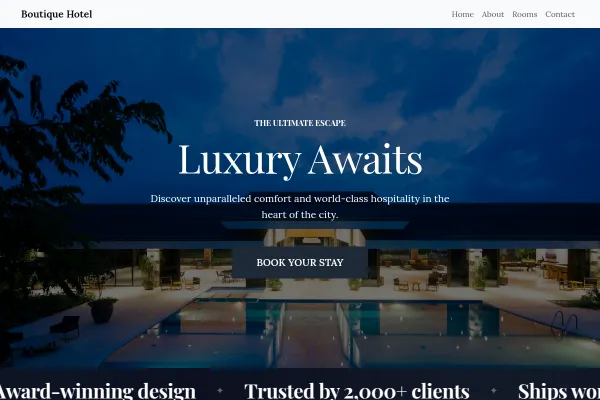
Georgian townhouse hotel: a brass key fob over a bedroom, the request form beside a pigeonhole key board, three rooms with their fobs, breakfast as a printed menu, and Bath in walking minutes.
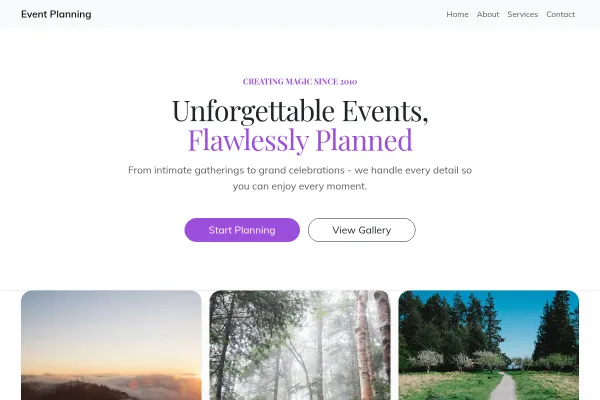
Event planner built around a production run sheet: a festoon-lit courtyard, rooms set an hour before the doors, a whole night minute by minute, and planning fees stated.
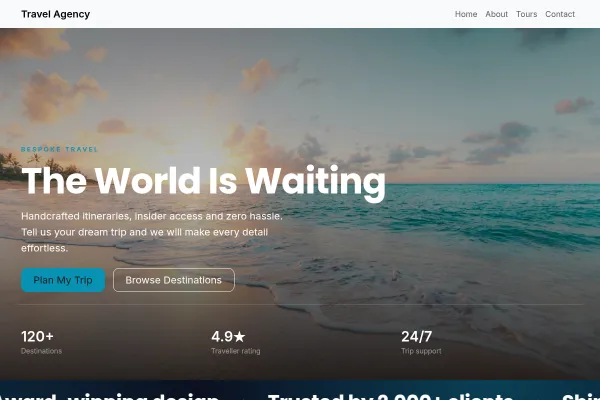
Tailor-made travel on a passport page: rubber stamps for every country over a Lofoten harbour, six destinations stamped, how a trip is planned, and a fourteen-night sample itinerary.
We use strictly necessary cookies to run the site and, with your consent, analytics cookies to understand usage. See our Cookie Policy and Privacy Policy.
 Hospitality & Events
Working bookings included · Starter plan
Hospitality & Events
Working bookings included · Starter plan