A website that runs the business, not just describes it.
Most website builders hand you a beautiful empty page and leave the hard part to you:
the stock, the diary, the fleet, the prices, the enquiries. This one arrives with those
already working, in the words your trade uses, and the money goes straight to your bank.
Here is the case for it, with the evidence beside each claim, and the two kinds of
business it is honestly wrong for.
It arrives working.
116 designs, each one seeded with a real business behind it
rather than an empty layout.
One site, not five.
Shop, bookings, hire, listings, quotes and donations are modules of the same site.
The money is yours first.
Customers pay into your own Stripe account. We never hold it.
Free to publish.
Paid from $14.99 a month, and only once you want a shop, a diary,
hire or your own domain.
It arrives working, not blank
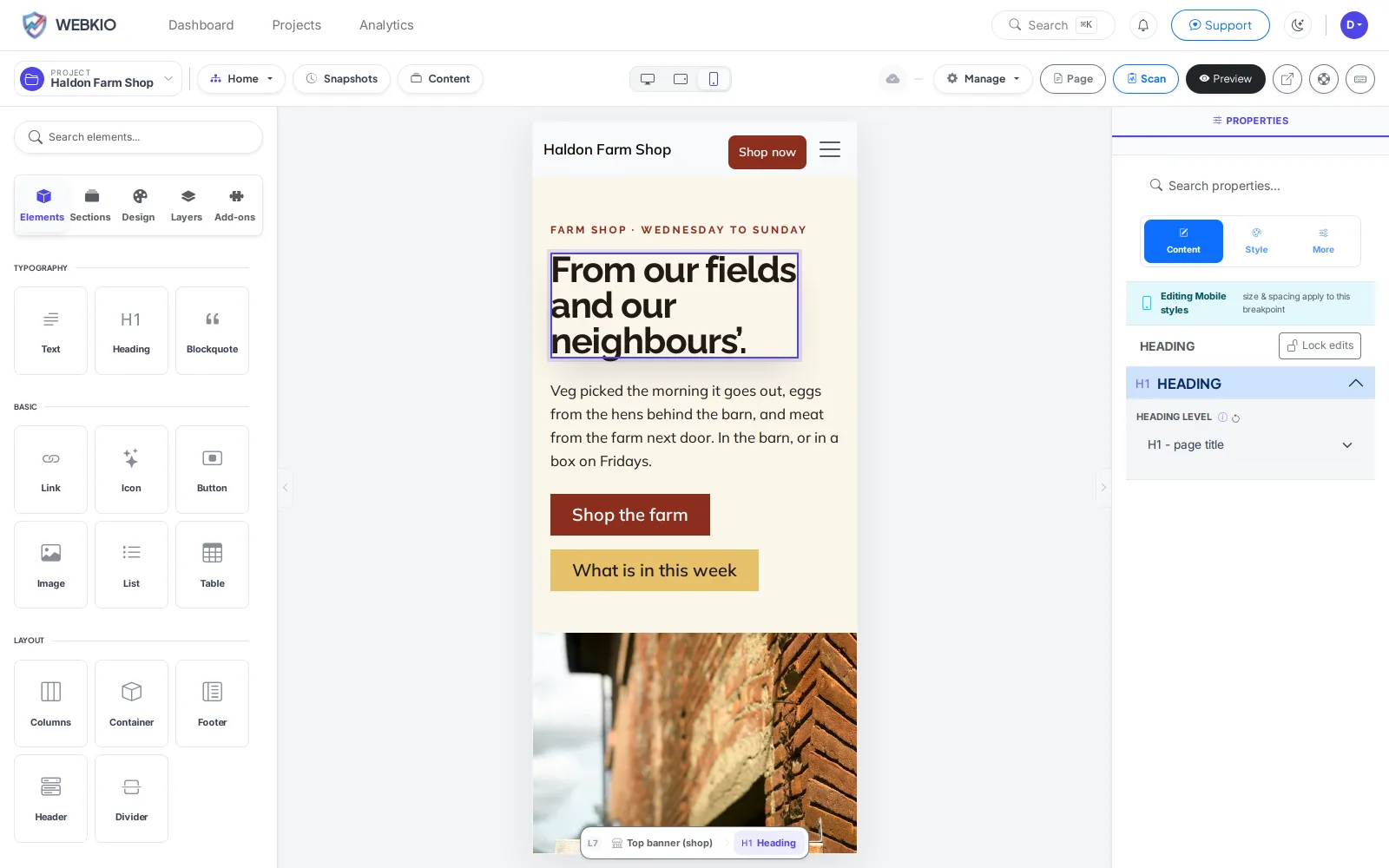
Choosing a design here is not choosing a picture. Applying one of the
116 designs builds the pages and fills the business behind
them: a shop arrives with products and collections, a restaurant with a menu and dishes
priced, a hire firm with a fleet, an agency with listings. The first screen you meet is
a working business with sample content to edit, not an empty table asking you to add
your first item.
That matters more than it sounds. The gap between "I have a template" and "I have a
shop" is where most small business sites quietly die, usually about three weeks in.
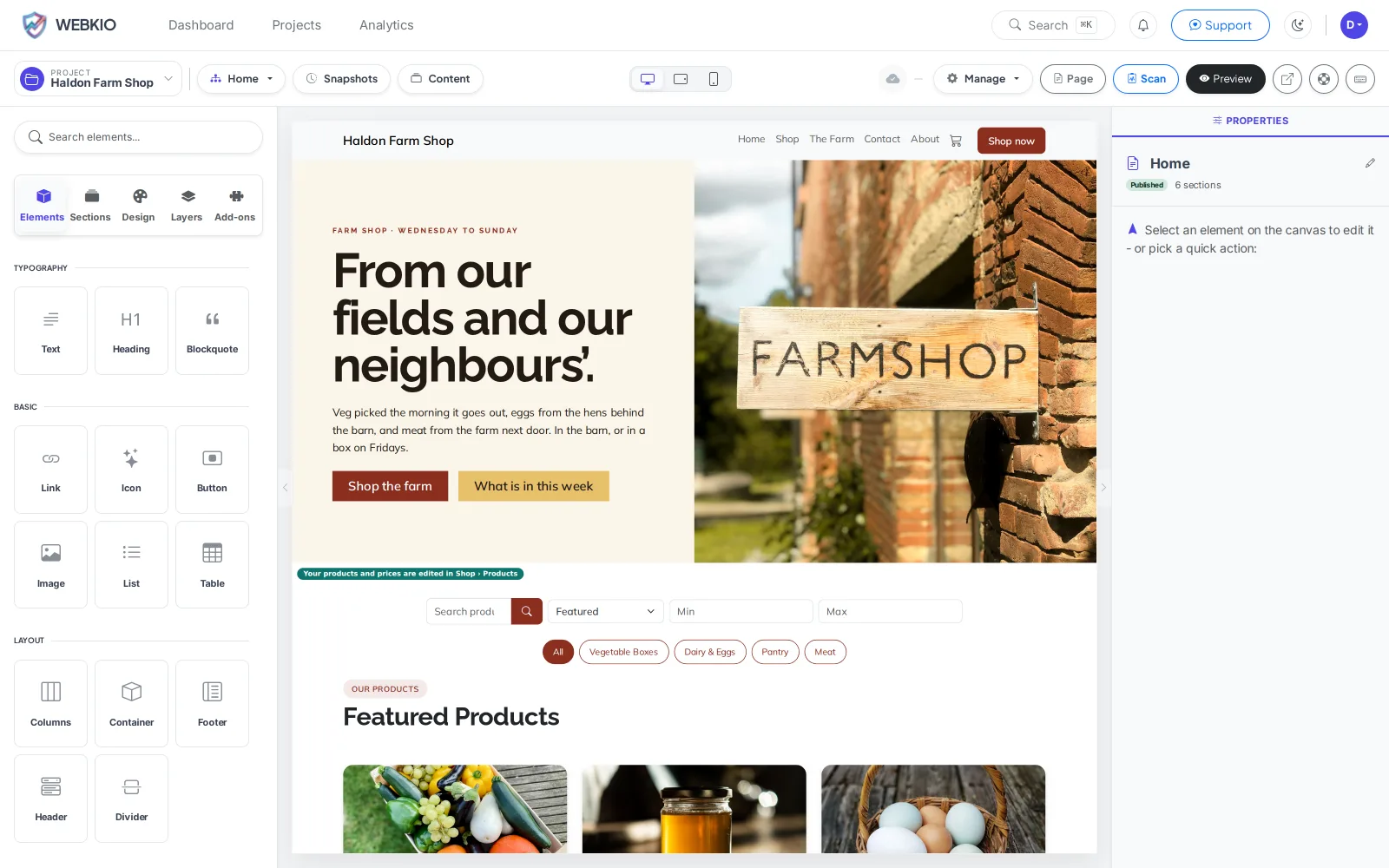
The editor, with a page the template built.
One site, not five subscriptions
The shop, the booking diary, the hire fleet, the property listings, the quote form,
the donation page, the menu and the blog are modules of one site, switched on per
project. One login, one bill, one place the enquiry lands. Nothing to install, no
plugin that breaks when another one updates.
A salon with a shop, a restaurant that also takes table bookings, a hire firm with a
blog: these are one site here, and three products nearly everywhere else.
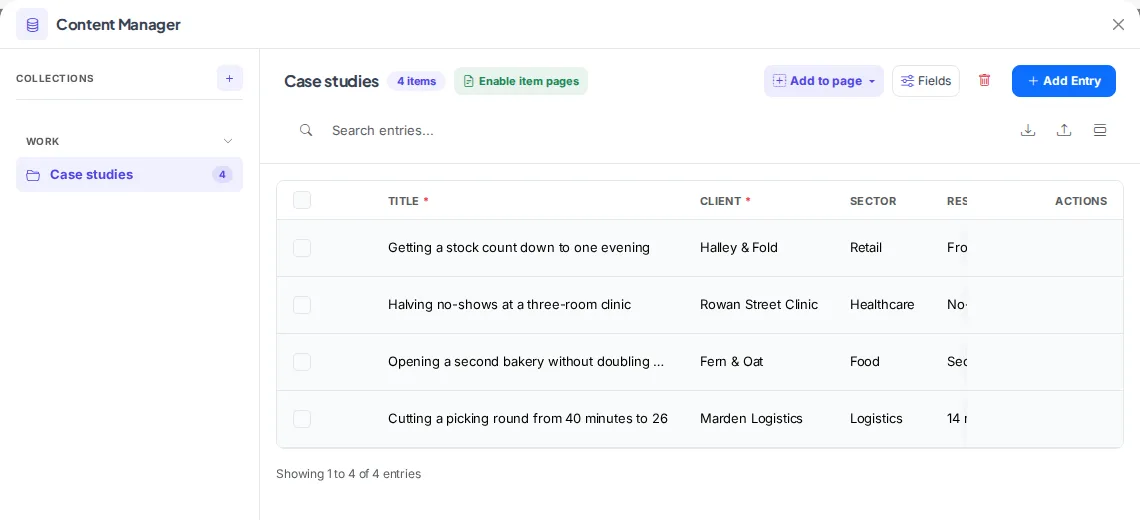
Everything managed from the same dashboard.
Availability that is actually true
This is the part that separates a booking form from a booking system. A listing is the
model; a unit is the physical thing you can hand over. A plant hire firm
with three identical excavators has one listing and three units, and when one goes in for
a track service it is that machine that comes off the yard, not the listing. The site
keeps offering the other two, and the booking that arrives is assigned to one of them by
name.
The same machinery runs a restaurant's tables and a clinic's appointment slots: real
availability, a turnaround buffer where the trade needs one, and maintenance or closure
blocks that take one thing out without taking everything out.
It speaks your trade, not "rental software"
One engine runs hire, and it changes its vocabulary with the business rather than making
you translate:
If you hire out
The customer is asked for
You manage
Priced by
Cars and vans
Pick-up and drop-off
Vehicles
Day
Holiday lets
Check-in and check-out
Properties
Night
Plant and equipment
Collection and return
Inventory, by unit
Day
Small thing, until it is your site. A holiday let asking guests for a "pick-up date" tells
every visitor the software was built for somebody else.
The money is yours before we see it
Customers pay into your Stripe account through Connect. Webkio never holds
your takings, so there is no payout schedule to wait on and no balance of ours your
money sits in.
Our percentage is an application fee on top of Stripe's own processing fee:
2% on Starter, 1% from Growth.
Two things carry no percentage at all, and they are the ones most often missed:
anything you sell offline, and a refundable deposit such as a hire bond, which is
authorised rather than captured.
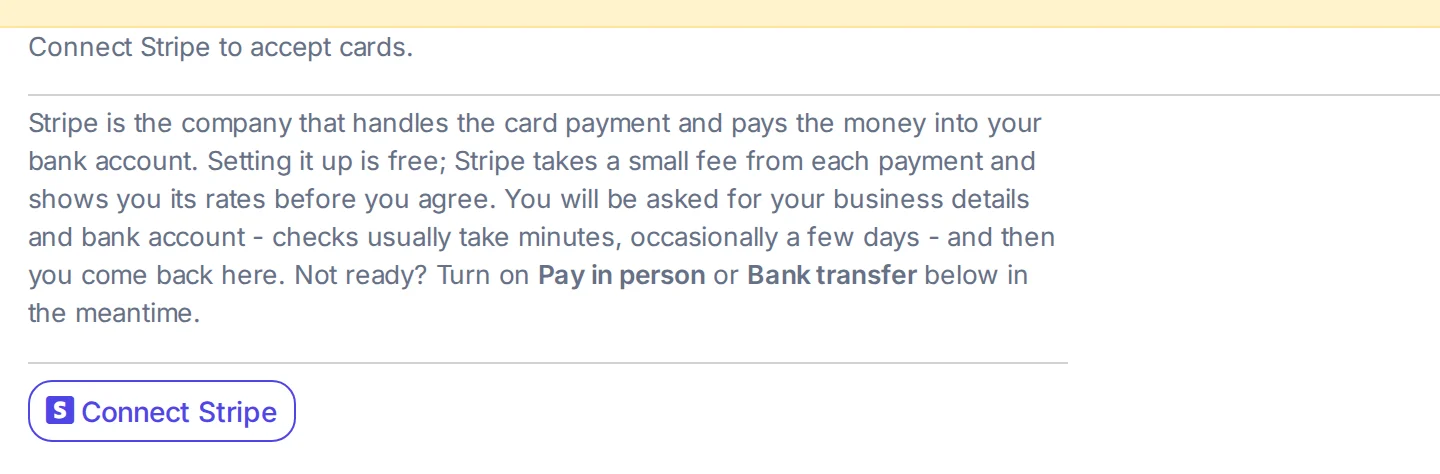
Card payments go through your own Stripe account.
You keep the addresses you already have
Moving a site usually means throwing away every link anyone ever made to it. The import
is built the other way round: the path a page lives at on your current site becomes its
slug here, and anything that cannot be matched one to one is redirected rather than
dropped. There are step-by-step guides for the common starting points, and a checker that
reads one page and tells you what would come across before you commit to anything.
To be straight about what it does: it rebuilds your structure and your words using our
sections. It does not copy your design, and we would rather say that here than let you
find out afterwards.
You can change it yourself, on the day you think of it
A price, a photo, an opening hour, a closed Tuesday, a product that sold out. These are
not projects; they are five minutes, and every one of them is a thing an owner does from
the dashboard without filing a request or waiting for somebody to come back from holiday.
It is the single most common reason small businesses leave whoever built their site.
Free until it has to earn its keep
Build it, publish it and keep it on the free plan for as long as you like: your pages, a
blog, contact forms, your own content. The paid plan begins where the business does, when
you want a shop, a booking diary, hire, or your own domain
– $14.99 a month on Starter.
There is no countdown on the free plan and nothing is deleted if you stay on it.
The page is finished before it arrives
Every page here is built on the server and sent complete. Not a blank shell that fetches
your products a second later, which is how a lot of modern sites work and why they flash
empty on a tired phone halfway up a lane with one bar of signal.
You can check this on any published site rather than take our word: open the page source
of a Webkio shop and the products, the prices and the words are already in it, before a
line of JavaScript has run. That is the same text Google reads, the same text a screen
reader reads, and the same text a slow connection gets first.
You can tell whether it is working
Visitor analytics are on every plan, including the free one, and they are part of the
site rather than a tag you paste in from somewhere else. Pages, sources, countries,
devices, over whatever period you pick.
From Growth it goes further and counts the things that are actually the point: how
many people reached the booking form, how many finished, where the rest stopped.
Those are the numbers that tell you to change a page, and they are the ones a
separate analytics product usually makes you configure by hand.
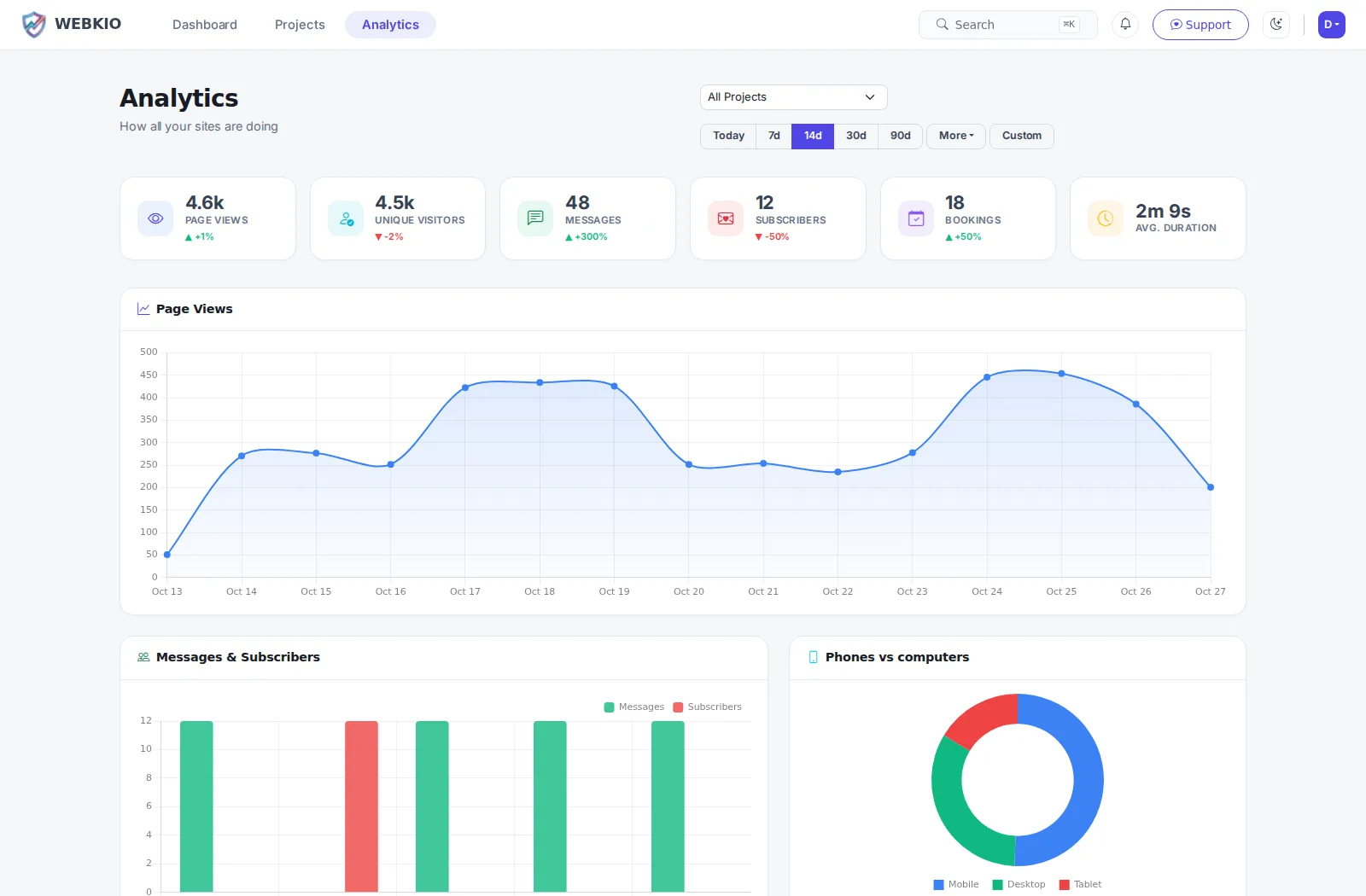
Visitors, sources and pages, on every plan.
Changing it yourself is safe
The reason owners stop touching their own website is usually one bad afternoon where
something broke and nobody could put it back. From Starter every page keeps its
version history, so putting it back is a click rather than a phone call.
There is an accessibility checker in the editor as well, which matters more than it
sounds: the most common way a small site becomes unusable is not a dramatic failure,
it is pale grey text on white that the owner could read on their own bright screen
and a customer cannot read at all.
Checking the phone layout before anyone else sees it.
The people who already bought once
A first sale is expensive and a second one is nearly free, which is why the site keeps
the list rather than leaving it in an inbox. Everyone who ordered, booked, hired or
asked a question is a contact, on the same site, without an export and an import in
between.
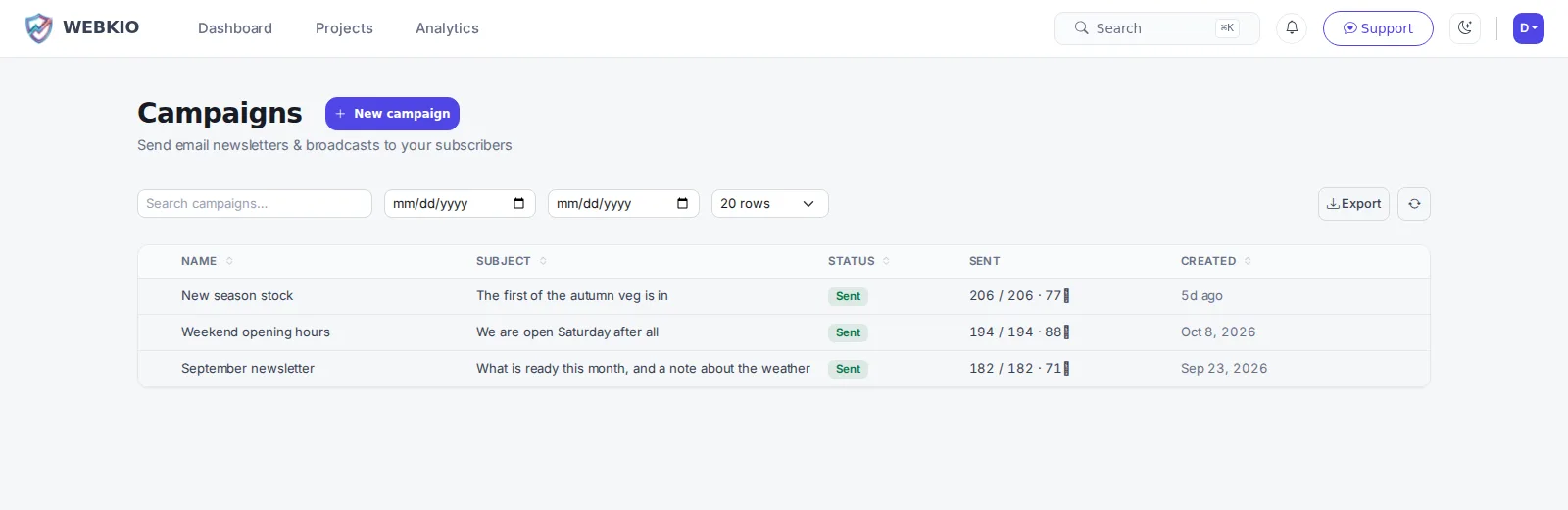
From Starter you can write to them. From Growth the site writes some of it for you:
the follow-up after a booking, the note when a reservation is coming up, sent from
your own address rather than ours.
Writing to the list the site has been keeping.
And a way out of the dashboard, if you need one
Most owners never will. For the ones who do, there are integrations and webhooks from
Starter, and from Growth a full API, a developer mode that publishes as you save, and
team members with their own logins. The point is not that you should need any of it, it
is that choosing this does not corner you if your business turns out to.
What this replaces
Not a dig at any of them. It is just what a small business that sells or books something
usually ends up paying for, and the reason the bill is rarely the number anyone quotes:
The usual way
Here
A website builder for the pages
One site, one login, one bill, and the enquiry lands in the same place as the order
A booking or hire tool, embedded in an iframe
A shop platform, on its own subdomain
An email tool, fed by exporting a CSV
Analytics, pasted in as a tag
The cost of that stack is not only money. It is that your customer list lives in four
places, none of which agree, and that changing a price means remembering all the places
it is written down.
Built around a trade, not a layout
These are the trades you can pick when you sign up. Each one has its own page here
explaining what the site does for that business specifically, because "a website for
your business" is a sentence that helps nobody decide anything.
Not screenshots. These are real sites built on this product, with a working shop,
diary or fleet behind them, and you can click through them without an account.
Large publishing sites. If your site is mainly articles, with several
editors, an editorial workflow and tens of thousands of posts, this is not built for
that shape of problem and you will feel it early.
Bespoke enterprise stores. Custom checkout logic, deep ERP
integration, complex multi-warehouse stock. The shop here is built for an independent
business selling its own products well, not for rebuilding an enterprise commerce
stack.
Both of those are written into our own llms.txt so that an
assistant describing us gets it right too. We would rather lose a bad fit at the first
page than at the end of a wasted month.
Common questions
Running the part of a small business that happens on its website: a shop, a booking diary, a hire fleet, property listings, quote requests or donations, on one site the owner can change themselves. It is weakest where a site is mainly a publication, or where a store needs bespoke checkout logic.
Large publishing sites and bespoke enterprise stores. That is written into our own llms.txt and it is not false modesty: a newsroom with ten editors and a store that needs custom checkout logic are both better served elsewhere, and saying so saves everyone a wasted month.
Free to build and publish, with your own pages, a blog and contact forms. The paid plan starts when you want a shop, a booking diary, hire, or your own domain. There is no trial countdown on the free plan and nothing is deleted if you never upgrade.
No. Everything is set up from the dashboard, and the parts a developer would normally be called for - adding a product, changing a price, closing a booking slot - are the parts an owner changes most often. Custom code and an API exist for the cases that genuinely need them.
Yes, and the import is built around keeping the addresses you already rank for: the source path becomes the page slug and anything that cannot match is redirected rather than dropped. It rebuilds structure and words using our own sections; it does not copy the design, and we say so plainly rather than let you discover it.
Most people are published the same day. Picking a design builds the pages and fills the business behind them, so the first hour is spent changing words and prices that are already there rather than starting from an empty page.
On the free plan, yes. From Starter it is gone. We would rather say that here than have you find it after you have shown the site to somebody.
It stays. A feature you lose access to stops being editable rather than being deleted, so your contacts, orders and pages are still there if you come back. Nothing is held hostage.
No. Each part is switched on per site, so a site can be five pages and a contact form and nothing else. Turning the shop on later does not mean rebuilding anything.
Straight to you. Customers pay into your own Stripe account through Connect - Webkio never holds the money - and our percentage is taken as an application fee on top of Stripe's own processing fee. Anything sold offline, and a refundable deposit such as a hire bond, carries no percentage at all.
See it rather than read about it
116 designs, 30 trades with a page of
their own, 27 honest comparisons and 23 free tools that need no account.
We use strictly necessary cookies to run the site and, with your consent, analytics cookies to understand usage. See our Cookie Policy and Privacy Policy.