Marketplaces rent you customers; your own store owns them. No per-sale commission, no algorithm burying your listings, and every buyer email is yours for the next launch. Here's the practical path from zero to first order.
Start narrower than feels comfortable
A focused shop of twelve products outsells a scattered fifty. Lead with your best sellers, group the rest into two or three named collections, and let the range grow from what actually sells. Every extra category adds navigation, photography and maintenance cost.
Product pages do the selling
Each product needs:
- Photos: square, consistent lighting and background, multiple angles - and on a person or in context where it applies. Photography is the single highest-leverage hour you'll spend.
- A short, honest description: what it is, what it's made of, what problem it solves, sizing or dimensions. Lead with the detail buyers compare.
- The logistics: price, shipping cost and time, returns. Surprises at checkout are where carts go to die.
The trust checklist for a new store
Unknown shops must earn the card number: a real about page with your face and story, a physical address or at least a country, plain-language shipping and returns pages, an email that gets answered, and card payments through a recognised processor. Webkio stores run Stripe checkout - buyers see a payment flow they already trust.
Price in the true costs
Product cost + packaging + shipping + payment fees + your time. New sellers habitually underprice; "cheap" is a losing position against giants anyway. Compete on story, specialisation and service instead.
Launch, then let data steer
Don't wait for perfect. Ship with your core range, then watch what the orders tell you: bestsellers deserve better photos and a featured slot, dead products deserve retirement, and abandoned carts deserve a recovery email - Webkio can send those automatically once you're rolling.
Get the checkout out of the way
Every extra field and step between "add to cart" and "paid" costs you orders. Offer guest checkout (never force an account), ask only for what you need to ship, show the shipping cost before the final step, and make sure the whole flow works one-handed on a phone - most first orders happen there. Card payments through a recognised processor do double duty: they're secure, and they signal "this is a real shop."
Decide shipping before your first sale
Shipping surprises are the top reason carts are abandoned, so pick an approach and state it plainly: a simple flat rate, free shipping over a threshold (which nudges bigger baskets), or live carrier rates. Weigh and measure a typical parcel once, price packaging in, and put delivery times on the product page - not hidden at the end.
Help shoppers actually find your products
A store is a stack of landing pages, and each one can earn search traffic. Give every product a unique, descriptive title and description (never the manufacturer's copy everyone else is already using), group products into named category pages that match how people search, and let genuine reviews accumulate - they add fresh, keyword-rich text and the social proof that converts. A clean structure plus honest detail is most of product SEO.
Turn one order into two
The cheapest customer is the one you already have. A short post-purchase sequence - a thank-you, a "how's it going?", a review request, then a reason to come back - quietly lifts repeat rate. Capture emails at the footer and at checkout so a launch, a restock or a sale reaches people who already trust you.
Frequently asked questions
Do I need a business licence to sell online?
It depends on where you are and what you sell. Many places let you start as a sole trader with no upfront licence, while some products (food, cosmetics, alcohol) are regulated. Check your local rules early - the website itself doesn't change what you're allowed to sell.
How do I take payments safely?
Use a recognised processor like Stripe, which handles the card data and PCI compliance for you - the numbers never touch your site. You're paid out to your bank on a schedule, and buyers see a checkout they already trust.
How many products do I need to launch?
Fewer than you think. A focused range of ten to fifteen well-photographed products converts better than a sprawling catalogue, and you can always add more once you see what sells.
Can I sell digital products or services, not just physical goods?
Yes. Downloads, bookings and services work the same way - you just skip shipping and deliver the file or confirm the appointment automatically.
How are taxes and shipping handled?
You set your shipping rates and tax settings once in the dashboard and they apply at checkout automatically. Start simple (a flat rate and your local tax) and refine as you expand into new regions.
Start from a working store, not a blank one
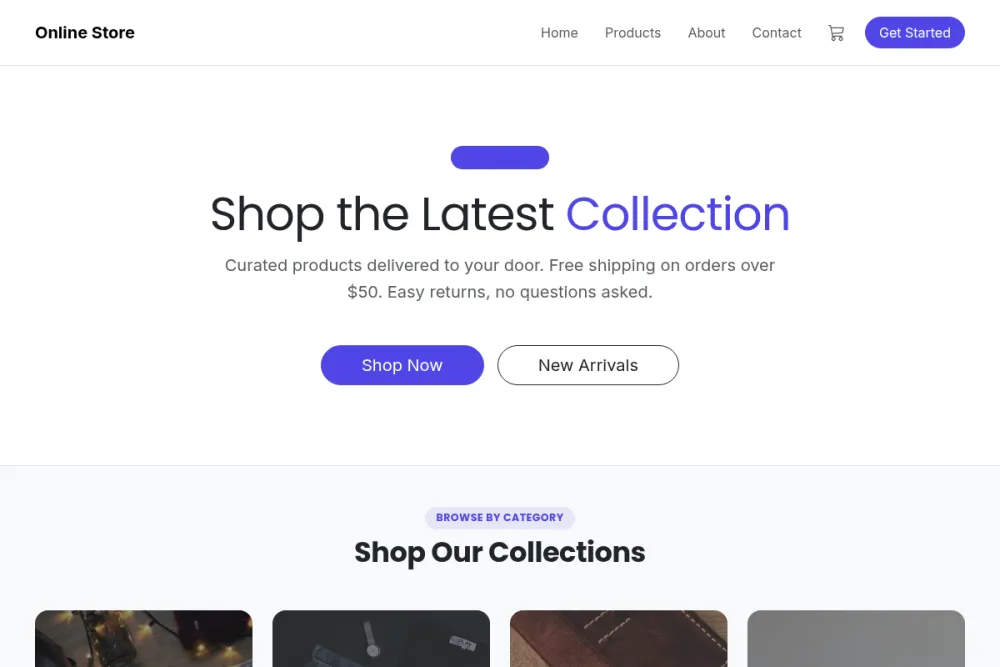
The free online shop templates provision a working store on day one - product grid, cart, Stripe checkout, seeded with demo products you replace: E-commerce as the general-purpose storefront, Boutique for fashion, Handmade for makers and artisans. Orders, inventory and customers are managed from the same dashboard you edit the site with.
Start free - swap in your products this weekend and take the first order that's 100% yours. The online store builder page is the same ground covered as a product rather than as a checklist.
FAQ
Is it cheaper to sell on my own site than a marketplace?
Usually, yes. You pay a subscription and card fees instead of a commission on every order, and the customer relationship stays yours.
How many products should I launch with?
Fewer than you think. A tight, well-photographed range sells better than a sprawling catalogue you cannot keep current.
What do I need before I can take the first order?
Products with prices and photos, a connected payment method, your shipping rates, and a checkout you have tested by buying something yourself.
Compare your options
- Webkio vs Shopify - how a store-first platform compares.
- Webkio vs Square Online - and the till-first route.
Read next
- Adding a shop to a website you already have - if the site exists and only the selling is missing.