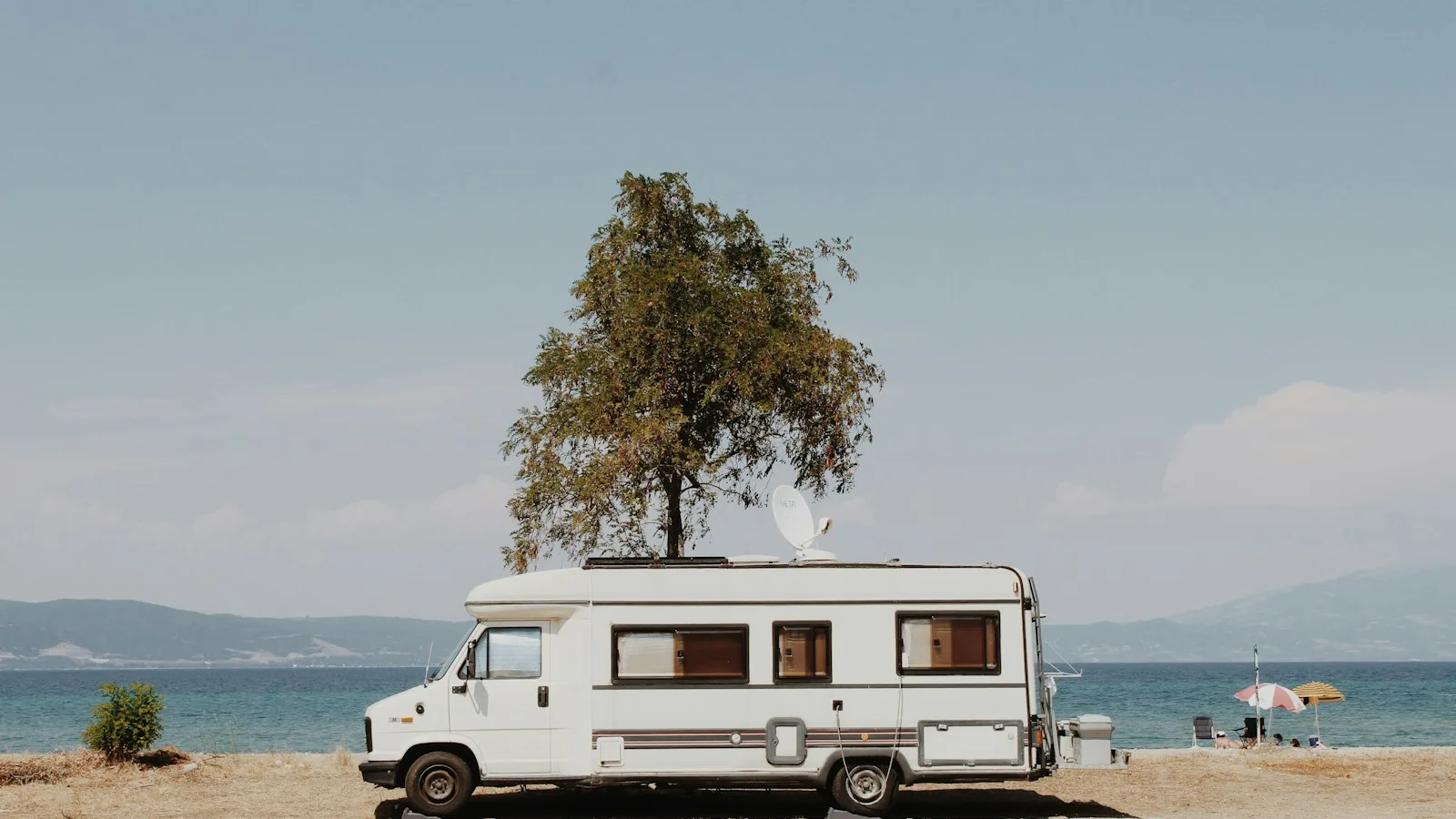
A camper van comes back at ten on a Saturday morning with sand in the bed, a scrape along the awning and 140 miles more on the clock than the rental included. At three that afternoon a family of four is due to pick it up for nine days. Whether that afternoon is calm or a scramble was decided weeks earlier, by a handful of settings: how long you leave between rentals, how big the deposit is, whether the mileage allowance was on the quote, and whether the awning clause was in the terms the last customer accepted.
This guide follows one rental from the search to the deposit coming back, and stops at each decision a rental business has to make to take bookings online. The example throughout is a small firm with five camper vans, because a camper touches every rule there is: mileage, seasons, minimum stays, turnaround and a deposit big enough to matter. Bikes, boats, equipment and vacation homes run on the same rules with different numbers, and there is a table for them further down.
If you take appointments rather than rent things out, the guide to taking bookings online is the one you want; a haircut is a slot of someone's time, and a van is a thing that leaves the yard.
Before anyone searches: one item, several units
The first decision is how to describe the fleet, and it decides whether you can ever be double-booked.
Our firm owns three identical two-berth vans and two four-berth ones. That is two items in the booking system: "Two-berth camper" with three units, and "Four-berth camper" with two. A customer does not care which of the three identical vans they drive away in, so they should not have to pick one. They pick the kind, and the system finds a free unit.
The rule of thumb: if two vehicles differ in something a customer would choose on, they are separate items. If they differ only in the plate, they are units of one item.
Units are what availability is counted on. The two-berth stays bookable for a week in August until the third van is taken for that week, and then it disappears for those dates and only those. The calendar shows which van went to whom, so on the day you hand over the right keys. When one van needs a new clutch, you block that one unit for four days and the other two keep selling.
The way a small fleet actually gets double-booked is two bookings arriving through two doors: a phone call written into a calendar while a web booking for the same week comes in. A booking system closes that gap only if every booking goes through it, including the ones you take by phone. Enter phone bookings as reservations, not notes. The double-booking demo shows what the check at save time refuses, and how double bookings happen covers the rest.
The calendar's rules
Five settings decide when a van can be booked at all. Set them once, for the whole fleet, before the site goes live.
| Rule | What it does | The camper firm's setting |
|---|---|---|
| Minimum notice | The least time between booking and pick-up | 24 hours, because a van needs prepping |
| Booking window | How far ahead someone can book | 365 days |
| Same-day cut-off | When same-day pick-ups stop | Not needed with 24 hours' notice |
| Gap between rentals | Turnaround time after each return | 5 hours |
| Time-aware availability | Whether pick-up and return times count, or only dates | On |
The two rows at the bottom of the table interact, and they are where money leaks without anyone noticing.
With time-aware availability off, the system thinks in dates. A van returned on Saturday can go out again on Saturday, which is right for a business that hands over at the same desk. But the moment you add any gap between rentals, it is rounded up to whole days. A five-hour gap becomes a full day, and the next customer cannot pick up until Sunday.
Here is what that costs the camper firm. In the 14 summer weeks, a van rented Saturday to Saturday can go out 14 times. With the gap rounded up to a day, each rental cycle is eight days instead of seven, so the van fits 98 ÷ 8 = 12 rentals. At the summer rate of $225 a day, two lost week-long rentals are 2 × 7 × $225 = $3,150 per van, or $15,750 across five, for a gap of five hours that was meant to be an afternoon.
With time-aware availability on, the gap is exactly what it says. The van due back at 10 AM can be picked up from 3 PM. So the decision is: if you set a gap, turn time-aware on and ask for pick-up and return times.
To find the right gap, time three real turnarounds. A camper needs the waste tanks emptied, the bedding swapped, the propane checked, the inside cleaned and the outside walked around for damage. If that takes four hours on a good day and five on a bad one, set five. Set it to the bad day, because the customer arriving at three does not care which kind of day you had.
Two more settings belong here. Blackout dates stop new bookings on days you are closed without canceling the ones you have. Maintenance blocks take one unit, or the whole item, off sale for a range of dates. The availability docs list what refuses which date when a customer reports one they cannot book.
The quote: show the total before anything else
A customer comparing three rental firms is comparing totals. The rate on the item page is where the price starts, and every fee that appears for the first time at checkout is a reason to close the tab. For vacation homes in the US it is also the law: the FTC's rule on unfair or deceptive fees, published in January 2025, covers short-term and vacation rentals and requires the total price to be shown more prominently than any other price. For vans and bikes it is simply what keeps people on the page.
Here is the family's nine-day rental of the four-berth, picking up on September 1 and returning on September 10, built line by line. The firm's high season runs to September 5 at $225 a day; the rest of the year the van is $165. The return day is not charged, so this is nine days.
| Line | Arithmetic | Amount |
|---|---|---|
| High season, Sep 1 to 5 | 5 days × $225 | $1,125.00 |
| Regular rate, Sep 6 to 9 | 4 days × $165 | $660.00 |
| Weekly discount, 10% of the rental | 10% × $1,785 | −$178.50 |
| Zero-deductible protection | 9 days × $28 | $252.00 |
| Bike rack | 9 days × $8 | $72.00 |
| Kitchen set | one-off | $40.00 |
| Sales tax, 6% on everything except protection | 6% × $1,718.50 | $103.11 |
| Total | $2,073.61 | |
| Mileage included | 9 days × 200 miles | 1,800 miles |
| Security deposit | held on the card, not charged | $1,000.00 |
Three things in that table are decisions.
Rates are per day, so a rental that crosses a season boundary pays partly at each. Five days at the high rate and four at the regular rate is fair to both sides, and it is the only answer that does not invite an argument. Put next year's seasons in before this year's peak ends; seasonal pricing for rentals explains how many to have, and the seasonal rate calculator turns an occupancy target into the rates.
The minimum stay comes from the day the rental starts. The firm requires five days in high season, so a three-day weekend starting August 29 is not offered, while the same three days starting September 6 are. Without that rule, a two-day booking in the middle of a peak week can leave five days nobody else can use.
The mileage allowance and the deposit are on the quote even though neither is in the total. The customer sees 1,800 miles before they pay, so 140 miles over is a sum they agreed to rather than a surprise. Whether to cap mileage at all is its own decision, and unlimited or limited mileage works through it.
Some firms hide prices altogether and quote on request, which makes sense for an excavator priced per job and almost never for a camper. A customer who has to email for a price can just as easily email your competitor.
Getting paid, and the deposit that expires
The rental payment and the security deposit are two different things, and mixing them up causes most of the trouble in this part of the business.
The rental payment
There are three ways to take it, and a firm can offer more than one:
- Card, in full, when they book. The booking is confirmed when the payment is, and a family who has already paid $2,073.61 has every reason to show up. For campers and boats this should be the default.
- Cash, bank transfer or check at pick-up. The reservation is held as unpaid until you mark it paid. This suits a bike shop where most rentals are walk-ups the same week, and it suits regulars.
- Request only. The customer asks, you confirm, and you take payment however you like. Useful while you are still learning what your rules should be.
Then the cancellation window. The camper firm sets 14 days. A family that cancels earlier than that is refunded automatically; inside it, the customer is asked to contact the firm and the decision is the owner's. The reasoning behind 14 days: with two weeks to go there is still time to sell nine days of summer to someone else; with three days to go there rarely is, and that is $2,073.61 of van sitting in the yard. A bike shop renting by the day might use 24 hours. Write the policy in words as well, shown before booking and in the confirmation; the cancellation policy generator drafts one, and cancellation and no-show policies covers what to put in it.
The security deposit
A deposit is a hold on the customer's card. Nothing leaves their account unless something comes back damaged, and the plan's transaction fee is never taken on it, because nothing has been sold.
The catch is that a hold does not last. Stripe's documentation says an online card authorization is typically on hold for 7 days, after which it is released whether you have used it or not. So the timing matters:
- Place the hold at booking, three weeks ahead, and it has lapsed long before pick-up.
- Place it a few days before pick-up, and it covers a weekend rental with days to spare.
- A rental longer than about four days outlives any hold placed before pick-up, because the hold has to exist before the keys go out.
Take the firm's two rentals that Saturday. The van that came back scraped had been out for three days, so its $1,000 hold was still alive. The awning repair is quoted at $240; the firm captures $240 and Stripe releases the remaining $760 by itself, because a partial capture automatically releases the rest.
The family's nine days are different. Their hold is placed on August 29, three days before pick-up, and lapses around September 5. The van comes back on September 10, five days after anything was held. So decide in advance what you do for long rentals:
| Option | What it costs | Suits |
|---|---|---|
| Accept the gap and rely on the terms | Nothing upfront; collecting for damage afterward means asking the customer to pay | Low-value items, trusted repeat customers |
| Take part of the deposit as a payment and refund it on return | The processing fee on that payment is not returned by Stripe when you refund | Campers, boats, anything where a $1,000 repair is plausible |
| Keep a larger deposit and a shorter maximum rental | Fewer long bookings | Equipment that is rarely needed for more than a few days |
None of these is wrong. What is wrong is finding out on September 10 that you never chose. How big the deposit should be is covered, trade by trade, in the guide to rental security deposits, equipment rental deposits and damage and vacation rental damage deposits.
Pick-up day
The day before, the customer gets a reminder email. Before that they read your booking page, where the "where to pick up" note from your rental rules appears, so make it more useful than the street address: "the side gate, not the shop door" saves a phone call every morning.
At the handover, record the state of the van so the return can be compared against something:
- Photos of all four sides, the roof and the interior, taken with the customer present. A dated photo settles in a minute what an argument settles in an hour.
- The odometer reading. The quote said 1,800 miles included; the return is measured against this number.
- Fuel and propane levels, if your policy is full to full.
- The license, checked against the number they gave when booking, if you collect one.
- The terms. The customer accepted your rental agreement at checkout, and the confirmation email links it. Point to the clauses that matter for a camper: no smoking, the waste tank, the awning in high wind.
None of this needs software. It needs the same five steps every time, and a phone.
Return day
Three numbers come back with the van, and each one is a decision you already made.
Mileage. The family returns having driven 1,940 miles against 1,800 included. At $0.35 a mile over, that is 140 × $0.35 = $49. Nobody knows the distance until the van is back, so the overage is taken by hand as a payment on the reservation. Do it at the counter, while the customer is there.
Fuel. If the policy is full to full and the tank is a quarter down, charge what your terms say. Deciding at the counter what feels fair is how two customers end up paying different amounts for the same quarter tank.
Damage. Compare against the pick-up photos. If the hold is still alive, capture the repair cost and the rest is released. If it is not, you are relying on whichever option you chose in the table above.
Late returns deserve a line in your agreement, because a van due at ten and returned at two eats the five-hour gap and makes the next family wait. Charge it by the terms the customer accepted. The booking system records when the van was due back; the time it actually came back is yours to note.
Then release whatever remains held, the same afternoon. Customers watch their card statements, and a hold that sits there for a week after a clean return is how a good rental ends on a sour note.
Renting the same van on another platform
Many rental firms list on a marketplace as well as their own site. That is a reasonable way to fill quiet weeks, as long as you know what you are paying: the commission calculator puts the marketplace's cut next to the cost of your own site.
The risk is the same van sold twice. Each item has a calendar address you can paste into Airbnb, Vrbo or Booking.com, which stops them offering dates you have already filled. It works in one direction: a booking taken on the platform does not block the dates on your own site, so enter it yourself the same day. Double bookings between Airbnb and your own site covers the gap, and if most of your bookings come through those platforms, a channel manager does a job this does not, which the comparison with Lodgify says plainly.
How the rules change by trade
The camper firm's settings are one set of answers. The questions are the same for every rental business, and the numbers change with the trade.
| You rent | Time unit | A starting gap to try | The deposit | The rule that matters most |
|---|---|---|---|---|
| Cars | Day | 1 to 2 hours | A hold, sized to the car | Mileage and fuel, because they are where return-day disputes start |
| Bikes | Day (a half day is a day) | Minutes; a check and a pump | Small, or none | How many bikes go out at once, since walk-ups and bookings share the rack |
| Boats | Day | An hour to a day | Large, often with a skipper's license | Weather cancellations, written before the first bad forecast |
| Equipment | Day, weekend, week | A clean and a safety check | Sized to the repair | Day, weekend and weekly rates, because a Friday-to-Monday job needs a price of its own |
| Vacation homes | Night | A changeover day | A damage deposit | Minimum stays and changeover days |
Each trade has a page showing a finished site: cars, bikes, boats, equipment and vacation homes.
The end of the season: four numbers
When the summer is over, the firm has a calendar full of evidence. Four numbers from it say what to change before next year.
Utilization per unit. Days rented divided by days the unit could have been rented. Across the 120 days from June to September, the firm's best two-berth was out 104 days (87%) and its four-berths 63 and 59 days (53% and 49%). Cutting the four-berth price would not fix that. The firm has one four-berth too many and one two-berth too few. Selling the slowest four-berth and buying a two-berth would put the van where the bookings are.
Lost revenue to minimum stays and gaps. Look for the holes in the calendar: two-day and three-day gaps between rentals that nobody could book. If the high season has a dozen of them, the minimum stay is too long for your market or the changeover day is the wrong one.
Lead time. How far ahead people booked. If the summer sold out by April, the high-season rate was too low, and the seasonal rate calculator gives a better starting point than this year's guess.
Disputes. Count the deposits you captured and the arguments you had. If the same clause caused three of them, the clause is unclear. Rewrite it before the fourth.
Mileage allowances, rental rates, deposits, utilization and the rest are defined, each with an example, in the car rental glossary; most of the terms apply to any fleet.
What Webkio does here, and what it does not
Webkio's rental module runs all of the above for cars, campers, bikes, boats, equipment and vacation homes, with the wording on every screen matched to what you rent. Items with units, the calendar rules, seasons with minimum stays, a quote that itemizes every line before payment, deposits held on the customer's card through your own Stripe account, card or offline payment, automatic refunds inside your cancellation window, a reminder the day before pick-up, and a calendar address per item. Customer payments go straight to your own Stripe account. Rentals start on the Starter plan; pricing has the item and reservation limits for each plan, and what a rental booking system needs is the checklist if you are comparing.
And the limits, so you know them before you rely on it:
- Prices are per day. A half day is a day; there is no hourly rate.
- The calendar address goes one way. Platform bookings are entered by hand.
- Mileage overage and late returns are taken by hand at return, as a payment on the reservation.
- Seasons are date ranges, not days of the week, so a standing weekend rate is set through the daily price and the weekly discount.
FAQ
How much security deposit should I take?
Size it to the most likely repair, whatever the rental price. A $40-a-day kayak with a $500 hull repair needs a bigger deposit than its rate suggests, and a camper's awning or a bike's derailleur sets the number for those trades. Whatever you choose, say it on the item page and in the quote so nobody sees it for the first time at pick-up.
Should customers pay in full when they book?
For anything rented for several days and booked weeks ahead, yes: a paid booking is a booking people show up for, and the cancellation window protects them if plans change. For short, same-week rentals such as bikes, payment at pick-up is reasonable and removes a step for walk-ins.
How long should the gap between rentals be?
Time three real turnarounds and use the slowest. Then turn on time-aware availability, or the gap is rounded up to a whole day and costs you a rental day every cycle.
Can I rent by the hour?
Not on Webkio: rates are per day, and a half-day rental is charged as a day. If most of your rentals last an hour or two, look for a system built around hourly slots; if they are mostly half days and full days, set the daily rate so that a half day still pays.
What happens to the deposit on a long rental?
A card hold lasts about a week, so on a rental longer than about four days it lapses before the item comes back. Decide in advance whether to accept that, take part of the deposit as a refundable payment, or shorten the maximum rental, and write the choice into your terms.
How do I stop double bookings with Airbnb or a marketplace?
Paste each item's calendar address into the platform so it stops selling your booked dates, and enter every platform booking on your own site the same day. The address carries your bookings outward; nothing carries theirs back in automatically.
Can customers pay cash when they pick up?
Yes. Turn on cash, bank transfer or check as payment methods and the reservation is held as unpaid until you mark it paid. Card payment can sit alongside them for customers who would rather pay when they book.