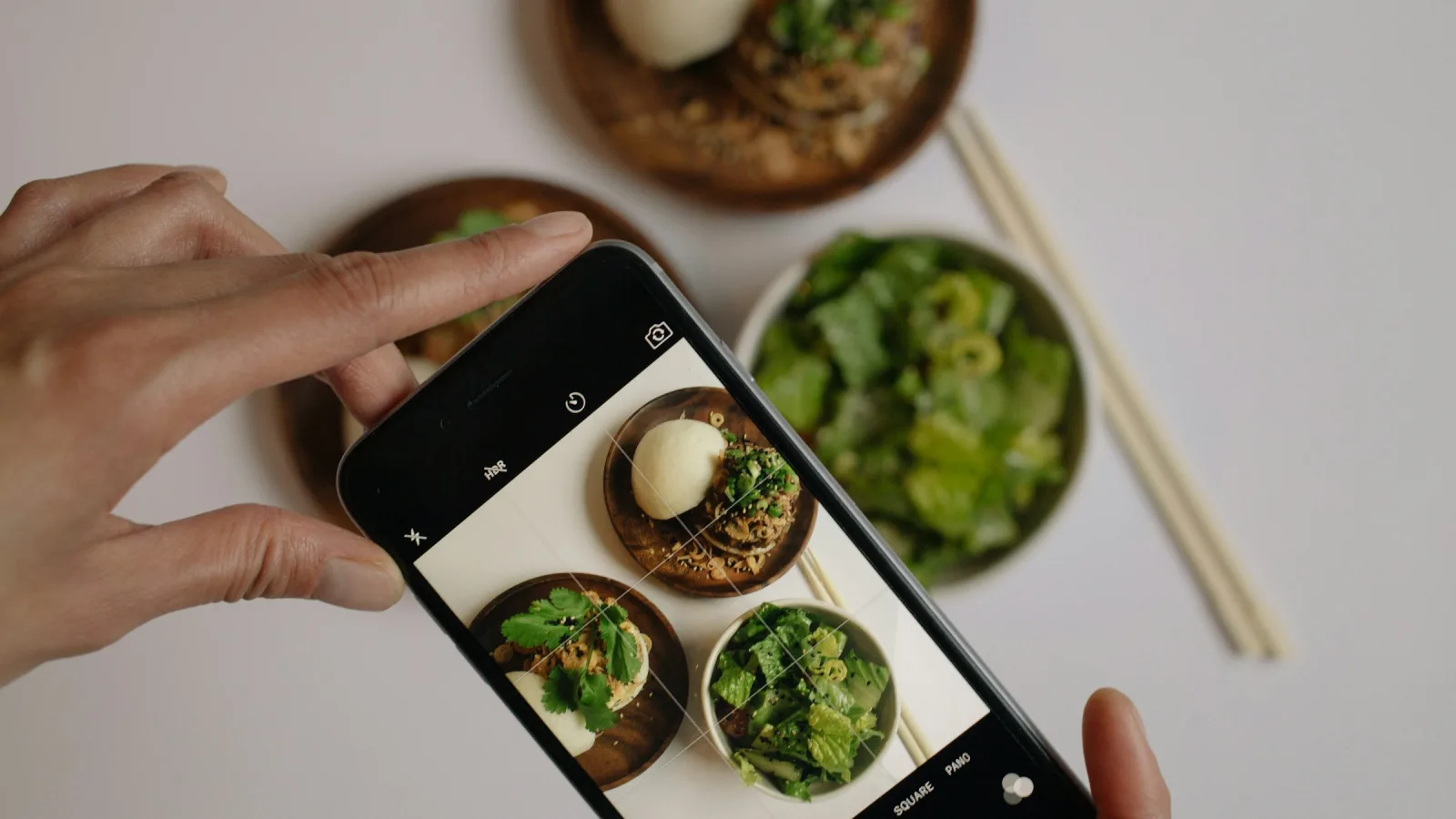
Most restaurant photographs are taken at half past nine on a Friday, in a dining room lit for atmosphere, on a phone held directly above a plate. That is three problems at once, and it is why so many good kitchens have a website that makes the food look worse than it is.
The dish photograph is the strongest thing on a restaurant site. People decide with their eyes and then read to confirm it.
Shoot in the morning
This is the whole trick, and it costs nothing. Daylight near a window, before service, with the overhead lights off. Restaurant lighting is designed to flatter a room in the evening, and it makes food look orange, flat and slightly grey in a photograph.
Plate one dish properly, carry it to the window, and shoot it there. It is not the room the dish will be eaten in and it does not matter.
The angle depends on the food
There is no single correct angle, which is where most phone photography goes wrong.
- Flat, layered plates - salads, pizzas, brunch, sharing boards - work from directly above.
- Anything with height - burgers, stacked pancakes, a pint, a dessert in a glass - is shot from roughly the level of the plate, or just above it. From above they become a circle.
- Bowls of things - ramen, curry, stew - want about 45 degrees, close, so you can see into the bowl.
Take all three of every dish and pick later. That is the professional secret and it costs nothing but a minute.
The five dishes worth doing properly
Not the whole menu. Five.
- The one you are known for. The dish people come for, whatever it is.
- The best-looking one. Not necessarily the same dish, and it is the one that gets shared.
- One from each part of the menu that people hesitate over. Usually the vegetarian option and the one with an unfamiliar name.
- A drink. Restaurants routinely photograph food and forget that a coffee or a cocktail sells too.
- The room, once, with people in it. Empty rooms photograph as closed businesses.
Everything else on the menu can be text. A menu of forty mediocre photographs looks worse than a menu of five good ones.
Practical things that fix most of it
- Wipe the plate rim. Nothing dates an amateur photograph faster than a thumbprint of sauce.
- One dish, not a spread. A crowded table shot shows nothing well.
- Get close, then closer. Most phone food photographs are taken from too far away and cropped badly afterwards.
- Do not use flash. Ever. It flattens the food and turns the sauce into a mirror.
- Shoot more than you need. Ten frames of five dishes is fifty photographs and about twenty minutes.
Then keep them light
A modern phone produces enormous files, and a menu page carrying twenty of them is a page that takes several seconds to appear on a phone - which is exactly the device your customer is holding while deciding where to eat. Resize before uploading, or use a platform that generates the smaller versions for you. Image optimisation for small business websites covers what to change.
The rest of the shot list for a business site, beyond the food, is in the seven photos your business website needs - and where the food photographs go once you have them is in putting your menu online.
Frequently asked questions
How do I photograph food for my restaurant website?
Shoot in daylight near a window before service, with the overhead lights off. Choose the angle by the food - flat plates from directly above, anything with height from plate level, bowls at about 45 degrees. Take several frames of each dish and pick afterwards.
Do I need a professional food photographer?
Not to start. Five good phone photographs taken in morning daylight beat forty taken during service, and they cost an hour. A professional is worth it once you know which dishes are worth the money, which is a decision the phone photographs will make for you.
Which dishes should I photograph?
Five: the dish you are known for, the best-looking one, the two people hesitate over such as the vegetarian option, and a drink. Photograph the room once with people in it. The rest of the menu can be text, because a few strong images beat a complete set of weak ones.
Why do my food photos look orange?
Restaurant lighting. Rooms are lit warm for atmosphere in the evening, and a camera records that as an orange cast that no filter really fixes. Daylight from a window, with the artificial lights switched off, solves it without any editing.